After waiting two weeks in Amanu, we finally get what we think is an “ok” weather window to head to Gambier. I say “ok” window because they are not “ideal” conditions, but they are doable. The 6-forecasts show NE winds with 1-2-meter seas, little rain and no storms. Since we are heading SE these conditions will work. This passage should take us 3-3.5 days based on our previous trips back and forth between these archipelagos.
What we learned during this passage was that the weather predictions were wrong 90% of the time. It wasn’t until the last 12 hours that the weather predictions were actually accurate. Little frustrating, yes! We downloaded new forecasts 2 times per day from 6 sources and they were all wrong. Why is it that weather forecasters can be continuously incorrect and yet still keep their jobs :)?
We left our anchorage at 0600 and had a leisure sail to the pass. Slack tide was estimated for 0700 so we did not want to arrive too early or too late. We managed to arrive at 0705 which was perfect and had no issues exiting the pass.
We decided to go around the NW side of Amanu which is about 18-20nm longer and out of the way. The reason we took this route was because it would give us a better angle for the trip (we make more easting). As it turned out, we had to go 30nm out of the way in order to clear the Amanu SE corner. But the good news was that it was a starboard tack (best tack for our boat) and beautiful sailing.
Then we began the pinching and bashing. Pinching means that we are sailing as close to the wind as possible while still trying to keep the sails filled. Sugar Shack can pinch to 38 degrees on a starboard tack and 45 degrees on port. We would be on a port tack the entire way to Gambier.
Fishing for Birds
On day 1 we put out 2 of the 3 fishing lines. We did not catch any fish, but we did catch a bird. We had at least 25-30 birds circling and eyeballing our fishing lures. It was pretty entertaining. For the most part they would just stick their beak in the water to try to get the lure. Missing most of the time and not able to pick it up once they got it.
It wasn’t until they starting diving (their entire body) that we got worried. We were pulling in one line when the other line went zing. Crap. We caught a bird. The only thing we can do is bring it in and try to free the poor thing. Within a few minutes it got free and sat on the water trying to regroup. We certainly cleaned its clock.
Then we put the lures on the poles as we waited for them to go away. And wouldn’t you know it, they found the lures on the poles and circled them while out of the water. Silly birds!

End of first 24 hours we made 119nm toward our destination.
Day 2
Pretty uneventful passage day. The boat is still pinching into the wind and bashing into the waves, but we are making progress and hanging in there. It is slow going and we are slowly growing our cross track. The cross track shows us how far off track we are. We cannot head directly toward our destination because the wind is not cooperating. But we are going in the “general direction.”
One fish got on the lure, made the fishing line go “zing” but it got off before we reeled her onto the boat. Bummer.
End of 48 hours we made another 128nm toward our destination.
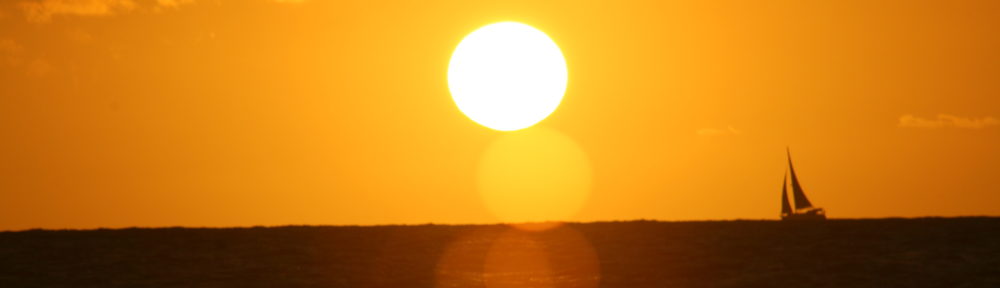
A beautiful sunset to end our day

Day 3
Wowza, totally crappy day on passage. We had 3+ meters seas (that’s over 9’!) and lots of squalls. We were constantly dodging the squalls and trying to make progress toward our destination. Not an easy feat.
Matt woke me up at 0500 to tell me we had two “fish on.” Oh boy. Lots to do. Matt starts reeling in one fish while I make preparations. Retrieve all required fishing gear (large container, bucket, cutting board, knives, gloves, pliers). I could not reel in the 2nd line so we let it drag. The pole was situated to the side of the boat behind the generator. You had to lift the pole up and over the helm to reel it in and the fish was too strong for me.
Matt got the first line in and left it dragging behind the boat – tuna! He got to the 2nd pole and barely got it over the helm. Unfortunately, he did not have purchase to reel it in so we had to move it to a different fishing holder. It had been at least 15 minutes, by the time we moved it again and he started reeling it in, we lost it. But we still got a tuna.

The 2nd lure (on the pole that lost the fish), was destroyed. Wonder what fish took ¼ of the fishing lure?
End of day 3 we made another 109nm toward our destination.
Day 4
We woke up to a much more pleasant day. We were still pinching and had waves on the nose, but they were back down to 1.8-2 meters. Much better, but still not ideal. It wasn’t until sometime in the wee hours of the morning that the weather forecast finally came to fruition. We got the NE winds that were promised and we were able to point directly to our destination. Thus, saving us from having to motor the last 50+ miles.
Our cross track had made it all the way up to 38nm! That means we were 38 miles off track. Not too terribly bad considering we could not point directly here for the past 3 days.
Land a Ho!
We spot Mt. Duff in the horizon and it is a sight to see! We were so happy to see the beautiful mountain peak and be close to the end of this passage.

Passage Details:
- Miles to Destination: 478
- Total Miles Sailed: 537 (59 miles our of our way)
- Total Moving Time: 98 hours 56 minutes (4 days 10 min)
- Max Speed: 11.0 (during a squall)
- Average Speed: 5.5kt
To give you some perspective: a 46’ Amel (monohull) left Hao at the same time we did. They had 60+ mile cross track and arrived 6 hours after we did. So, we are feeling pretty good about ourselves. As you know, any time two boats are headed in the same direction it is a race.
Passage Damage
Because the boat was bashing about from the waves, we had a wee bit of damage. Any passage can be hard on the boat and this one was no exception. The good news is that most of the damaged items are easily fixed – yeah!
- Jib Tact Shackle broke. We had one 90-degree shackle attached to another shackle that held down the tact (bottom part of the sail) of the jib to the furler. Kind of important as it keeps the sail attached to the boat enabling us to sail. At dusk on day 3, I saw the tact flapping around, called Matt and we discovered the problem. Matt was able to tie dynema (super strong line) to hold it down and we rolled the first portion of the jib to support it and prevent additional damage. Since we only had 100nm to go we decided to wait to do further repairs (see note below on repair)
- Starboard Alternator Belt Shredded: We have two alternators on each engine. The starboard large alternator has two belts and one became shredded and fell off. Alternator still works, so we continued on. Replaced it as soon as we got to anchorage
- Ceiling Fan Broke: In the master cabin, we have two ceiling fans. One fan was on during the super bad day and it bounced right off the ceiling and dangled from their wires. We were able to reattach it to the ceiling but the wires need some love. Will fix at anchor
- LED Ceiling Light: One of the starboard ceiling lights popped out of its hole during the bad day. We taped it back to the ceiling until we get to anchor.
- Two Fishing Lures: The fish were brutal to both lures taking at least 1/4 of each lure.

Repairing the Jib Tact Shackle
Once at anchor, and rested, we decided to fix the jib. Matt had to unfurl the jib which meant we needed a super calm day. Not wise to unfurl your sail while at anchor on a windy day.
The top 3 photos show the new shackle and dynema line that Matt added to hold the sail while we were at sea. We could not connect the two shackles while the sail was under pressure and it was too windy to take it down while we were under way.
There was a small 1/4” tear of the bolt rope which threads up the forestay. Negligible considering it could have been so much worse had we not caught it right away. We added a new shackle and secured the sail (bottom image).

All in all it was not our best or favorite passage, but we made it safely. Thank goodness.
Did you read about our adventures in Amanu in our last blog. Events from this blog post occurred at the early December 2021. Our blog posts run 10-12 weeks behind our adventures.
Like this:
Like Loading...