Author Archives: Christine

About Christine

The one that makes it all happen

View half way up the mountain

Gambiers Welcomes Us Back

What a pleasant surprise to pull into Rikitea (the main anchorage) with only 3 other boats!  If you remember from last season, we left when there were 35 boats in the same anchorage.  We found out that there are only 6-7 boats in all of Gambiers which is amazing and refreshing.  I am sure that will change once February rolls around that seems to be the time when the wind provides a better shot to this beautiful archipelago.

The weather was sunny, blue skies, and calm waters.  Rikitea had blue water and not the awful green murky water it’s known for.  Simply beautiful. We went ashore to see if we could find some fresh produce but most of the magasins (markets) were either empty or low on stock and quality.  The supply ships are coming soon.  We made a stop at Phillipe (the brioche guy) to do some internetting as we had been offline for 2.5 weeks and were not surprised by the very slow speeds!  Could not upload a photo to the blog and it took an extreme amount of patience to get to a website. Oh well, nothing new there.

Hike Around Mt. Duff

I am pretty sure Matt hoodwinked me.  He said he wanted to hike around Mt. Duff and hoped to collect some produce.  I should have asked for clarification about the hike as I was not ready for it at all.  It started out nice enough along the main road, behind the huge St. Michael cathedral and up toward the gap that separates Mt. Duff and Mt. Mokoto. 

The main road takes you past the Gambiers cemetery which has a mausoleum (which looks like a small church).  Inside the mausoleum is one grave.

Gambiers cemetery

Gambiers cemetery

Many of the gravestones have photos of the decease and either flowers or shells adorning the gravesite.

This same road takes you by the recycling area and the gravel yard.  The locals recycle cans, aluminum and glass.  Unfortunately, they do not recycle plastic yet.  If you go further down the road you will come to their dump, I did not think you needed to see that site.

Gambiers Recycling

Gambiers Recycling

We found a few papayas on the side of the road and loaded them into our back packs. 

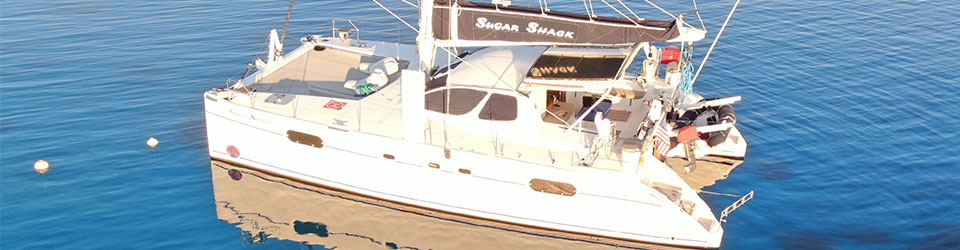
Just before the turn off to the main trail we had this pretty view of the anchorage.  Can you see Sugar Shack?

And the view the other way is equally pretty.

Aukena in the distance

Aukena in the distance

Once we reached the trail, we had already walked 3.2 miles (7,865 steps, 30 floors).  Yep, I was tired already and we have not even started the trail.  What did I get myself into?  Clearly, I am out of shape.

The start of the trail

The start of the trail

A higher view of the anchorage from the trail.  The water color is just magnificent, don’t you think?

View half way up the mountain

View half way up the mountain

The Trail

The locals must have just cleared the trail as it was lovely and easy to walk on.  Usually the trail is covered in raspberry bushes, overgrowth, pine needles and such.  There are a few areas where you still have to traverse across a landslide, climb over a tree, scurry over rocks, and wade through pine needles.  But for the most part the trail was awesome.

Along the first part of the trail (as you go up toward the gap between the two mountains) you will find lots of informative signs about the plants and trees.

Many types of ferns, coconut trees…

Flowering bushes and trees

Huge Elephant ear plants and grass

And more ferns and grass.

We found tons of fresh fruit including papaya, raspberries, chili peppers, pomplemouse, noni, oranges, limes, avocado, tomatoes, lychee, and mangos.  Most of the fruit was not ready for picking so we let it continue to mature.  But we did come away with raspberries, papaya, lychee, and pomplemouse.

So many fruit, so little time....

So many fruit, so little time….

You might wonder what lychee is. We had heard about this delicious fruit for two seasons.  This fruit only grows in cool climates like Gambiers and Australs and it only blooms in December.  Lychee is red and you peel it like an orange and then eat the tasty white nectar around the seed.  It is super sweet and divine!

Lychee the sweetest fruit

Lychee the sweetest fruit

Summit

We finally reach the summit.  Keep in mind that the gap summit is nowhere near the top of Mt. Duff or Mt. Mokoto.  It is tall, but not as tall as the two mountains.  But the views are superb.

Total hike was 6.8 miles, 16,757 steps and 93 floors.    If you look at this map, we took the black road that starts at Rikitea (top right), went down (bottom right), to the orange trail.  Then we took the orange trail up and over back to the red “You are here” bubble which connected back up with the black zig zag line and took us back to town. 

The gap between Mt. Duff (on right) and Mt. Mokoto (left).  We hiked between the two peaks.

By the time we got back to the boat, I was exhausted.  I poured a cold drink, took some advice, hopped in the shower, and then collapsed on the couch where I stayed for the rest of the evening.  Yeah me!

Matt:  My Goat

Matt is truly part goat. I  say that in a loving and admiring way.  He has incredible stamina and can hike for miles and miles and miles without getting tired.  When I work on the blog he goes for a hike or a walk.  Part of me is jealous as I’d love to go exploring with him, but part of me is relieved.  One because I can’t keep up with him and two because he is far more adventurous than I am.

One afternoon I spent well over 5 hours working on the internet (blog, banking, etc…).  Matt hiked over 10 miles around the tip of Mangareva.  He finally came back exhausted, bumped, and bruised, and tired.  It was the first time, in a long time, that I had seen him spent.  The photo says “8” miles but it was really 10!

Events from this blog post occurred around 12 December, 2020.  Our blog posts run 8 weeks behind our adventures.

A Journey: Tuamotus to Gambiers Part II

We originally started our passage from Tikehau with the hopes of making it all the way to Gambiers.  However, if you read “A Journey: Tuamotus to Gambiers Part I” you will see that we were thwarted and had to stop in Amanu for 10 days to wait for more favorable weather.  This blog post will be the second and final part to the Tuamotus to Gambiers passage.

Continuing our Journey to Gambiers

Matt and I left the South East anchorage at Amanu around 0930 on a Monday morning.  We needed to cross the Amanu lagoon, head out the pass, and travel down the atoll which added 16nm to our 450nm passage.  As we approached the pass to exit the lagoon, we noticed we had a 2kt outgoing current.  It turned out to be no problem for us as we exited.

The weather routing gave us four routes.  All of which had us turning left out of the pass and going between Amanu and Hao as it was the shortest distance.  However, that was a huge mistake.  We should have turned right, motored the extra 8-9nm and rounded the NE side of Amanu.  It would have given us a much better wind angle and prevented the horrible washing machine effect.

As we rounded Amanu, we encountered 3-meter waves coming from every direction.  It was a mess.  The waves were trapped between the two atolls creating a really uncomfortable start to our passage.  It lasted the entire length of Hao which is 33+nm long!  Rotten way to start the trip.  Especially because I never recovered from that moment forward.  I stayed in a state of sea sickness the entire trip.  Not my worst trip, but certainly not my best.

The first day we tried to make as much easting as possible. We were pinching (heading as close to the wind as possible) which forced us to constantly trim the sails to keep them full.  Sunset on first night.

First 24 Hours

  • 134nm Miles travelled over all
  • 337nm Distance to destination
  • 7 Max Speed
  • 6 Average Speed

Beautiful sunrise on day 2

On day two, we had calmer seas.  They dropped from 3-meters to 2-meters and were primarily on our forward quarter panel.  Still a bumpy, crazy ride.  Our course for the first 1.5 days was about 140-150T with an average of 12-18kts of wind from North of East.  We had to adjust course to avoid hitting a small atoll called “Tureia” in the middle of the night.  We had lots and lots of beautiful stars as the moon did not rise until 0100.

48 Hours

  • 290nm Miles travelled over all
  • 156nm Travelled in the last 24-hour period
  • 181nm Distance to destination
  • 4 Max Speed
  • 2 Average Speed

We were waiting on a wind shift to make our actual heading to the Gambiers.  Finally, during the 2nd night it started to shift a bit after Matt dwelt with 2 big squalls.  We finally had a course of 120T with winds at about 15-18kts from NE and 1.5-meter seas.  Our cross track was at +47 and we needed to widdle that down.  Happy to be heading directly to Gambiers with decent winds and smaller seas.

Matt took this really cool photo of the moon and sky as the sun was trying to rise.  If you zoom in you can see we are making 8kts of boat speed in 16kts of wind.  Pretty impressive.

72 hours

  • 466nm Miles travelled over all
  • 176nm Travelled in the last 24-hour period
  • 6nm Distance to destination
  • 6 Max Speed
  • 6 Average Speed

We entered the Gambiers pass with a reefed main and jib.  Normally we would take our sails down, but the wind was coming from the right direction and just pulled us nicely into the pass with no problems.  All in all, it was a decent trip.  We were able to sail the entire passage without the use of the motors (yea, save money on diesel).  Had it not been for the horrible beginning I probably would have felt better the rest of the trip. But, what can you do?

Final Passage Details

  • 73 hours travelled for entire passage – anchor to anchor
  • 481nm Miles travelled over all
  • 10.6 Max Speed
  • 6.6 Average Speed

Arriving at the Gambiers pass

Arriving Gambiers

Arriving Gambiers

Did you read “A Journey: Tuamotus to Gambiers Part I“?  Find out why we stopped and had to continue our journey 10 days later. 

Events from this journey occurred around the 2nd week of December, 2020.  Our blog posts run 8 weeks behind our adventures.

Astounding Amanu

This little atoll called Amanu has proven to be a true hidden gem.  The turquoise water is so clear that you can see 15-18 meters deep.  The corals are healthy, the motus are lined with beautiful, swaying palm trees, and the locals are friendly.

Sugar Shack at Amanu

Sugar Shack at Amanu

Amanu has gifted us with many beautiful rainbows (after a free boat wash).

And of course, gorgeous sunsets.

Amanu sunset

Amanu sunset

Sugar Shack seems to have found a little slice of heaven on the southeast side of Amanu.

Anchored in Amanu

Anchored in Amanu

Matt is happy here as well.

Kite boarders love this area because it is windy and shallow.  A young couple who have a kite school out of Fakarava were here with a charter.  They gifted us with many hours of free entertainment.  Pretty spectacular what they can do in high winds and seas. 

They were pretty far from us, but I tried to zoom in to capture them in the air.

Motus around Amanu

We explore lots and lots of motus.  So many that I cannot name them all because they don’t have names on our charts.  We walk from one motu, across small bodies of water to another motu and carry on until we get tired.  The terrain on the motus differs wildly.  From afar, there appears to be beaches. 

But very rarely do you find sandy shores.  The shores are usually covered in coral.  Broken coral, ranging in various sizes, and shells cover the shores. 

As you get to the windward side of the motus the coral is much larger.  These can be a little harder to walk across. 

And of course, you cross over many bodies of water in between.  Sometimes, during low tide you just have the sea bed (top left photo).  Often times you have ankle deep water (top right).  And other times you have a little sand (bottom right) and yet other times you have hard packed coral in between the bushes (bottom left).

The terrain of the motu

The terrain of the motu

We crossed over several low water crossings, using sandy spits to navigate to shore.  Some where above water, some below by 1′ and some as much as 3′.

One lone palm stood out on a motu.  We had to go visit it.  Do you see the palm way in the distance in the top photo?

A Whale inside the lagoon

We spotted two whales inside the Amanu lagoon!  What a treat.  Unfortunately, I did not have the large camera out to get good shots of this graceful creature.  But I did grab a few shots with my phone. 

She was about 100 meters (one football field) away. 

A whale inside the lagoon

A whale inside the lagoon

I loved watching the tale gently glide under the water only to see the spout shortly after.

The beautiful whale tail

The beautiful whale tail

Amanu has surprised and wowed us! 

Events from this blog post occurred around the 1st week of December, 2020.  Our blog posts run 8 weeks behind our adventures.