Category Archives: French Polynesia

French Polynesia islands including: Marquesas, Society, Astrolls, Tuamotus, and Gambiers

1950s Photo of Train and Conductor

Touring the Phosphate Island: Makatea Part I

We explore the historic and unique island of Makatea. We scheduled a tour with Le Maire (the mayor) Julien Mai.  He was born on Makatea, educated in Japan and speaks 5 languages.  Julien has been the mayor since 1995 and is a living history book for the island.  As I mentioned in an early blog post, Makatea is one of three islands in the Pacific that was mined for phosphate.  The mining is an enormous part of their history as we learned from Julien.

Mining Phosphate

So, what is phosphate used for?  It is a natural fertilizer.  The phosphate from Makatea was a huge contributor to the rise of Japan’s rice crop exportation in the mid-1900’s.  Over 3,000 workers and their families descended on the small island.  The workers extracted 11 million tons over 6 years during the most productive period of mining.  The miners used nothing by shovels and pure brute strength.

The workers mined the island from 1906 to 1966.  Men and women would work side by side in shorts and t-shirts, only sometimes hard hats and no shoes!  They would dig holes that measured 2-3 meters wide and 15-20 meters deep by hand.  They would use 2×4 pieces of wood to place over the holes in order to transport their findings.  Workers would push their full wheelbarrows with cat-like agility across the beams and over the cavernous holes to the dumping center.  I took the photo below from a TV shot during a documentary I watched, sorry its blurry.

Old phosphate mining photo

Old phosphate mining photo

The first wheelbarrow paid for their housing and the 2nd paid for their food.  The company paid anything after that in meager amounts at about $100-$150 per month.  It took 1 ton to fill up one funicular and it took 2 weeks to move 35k tons. 

Makatea after the mining?

In 1966 the entire workforce left Makatea to work with the French, on other islands like Hao, to do nuclear testing.  The workers and mining company left all of the equipment, tools, sheds, railroad tracks, trains behind.  The company never repatriated or repaired the island.  Instead, the company left the island with thousands of mining holes.  Only a few families stayed behind to protect the island.  The image below shows an old photo.  The top picture taken in 1954 and the below it is a photo I took on our tour – the holes remain largely untouched as a gaping reminder of the mining expedition.

Holes dug by phosphate mining

Holes dug by phosphate mining

Island Tour of Makatea

Julien started our tour began at the top of the hill just above the port which is called the “industrial area.”  This is where the majority of the welding, pressing, cleaning, and drying of the phosphate was handled.  Julien has plans to bring an industrial expert to the island to help create an open-air museum for the machinery.  However, at this time it is just rusting withering away.

Industrial Area at Makatea

Industrial Area at Makatea

For the most part, the locals do not want to touch or discard anything until the expert can come and evaluate it all.  The locals try to cut back the growth, but as you can see several pieces of the machinery are covered.

Phosphate Mining Machinery

Phosphate Mining Machinery

Lucky for me, Matt was able to identify a lot of the large machinery as he used to work in welding (bet you didn’t know that).  Several large drill presses:

Drill Press for Phosphate Mining

Drill Press for Phosphate Mining

Wondering if any of this equipment can be salvaged? No, which is such a shame.

Lathe and Mill

Lathe and Mill

We were not able to identify all of the machinery.  Any ideas?

Industrial Equipment

Industrial Equipment

Sculfort Fockedey manufactured most of the equipment we found.

Company who made most of the equipment

Company who made most of the equipment

In the back, behind a lot of vegetation and down a small hill was the power source, the engine.

The engine that powered the industrial area

The engine that powered the industrial area

An old train and part of the overhead distribution track are stark reminders of the grand mining system

Train and overheard track

Train and overheard track

How many train engines do you need on this small island?

Throughout the island are more train engines and train cars. We found 5 train engines.   Just imagine the worker stopping the train, getting out and it never moves again.  The photo below shows 3 train engines that we found.  The bottom photo is from the 1950’s

Train Engines left everywhere

Train Engines left everywhere

Miners used the tracks to move the phosphate from the center of town to the port.  The top photo from 1950, shows the men working on the track.  The lower photo is what the tracks looks like today.

Tracks from the 1950s and today

Tracks from the 1950s and today

Miners loaded phosphate  into large open top containers to be transported by train.  Then the workers dumped it into the funiculars which took it to the post.

Train carts used to transport the phosphate

Train carts used to transport the phosphate

The Port

The port had a very different feel back in the 1900’s.  It was a bustling center of activity where the phosphate would be cleaned with fresh water, dried, then loaded into the ships.  The complex distribution system used wheelbarrows to carts, then trains, and then funiculars to get it from the holes to the port.  These are photos of the port from 1950’s.

Makatea port in 1950s

Makatea port in 1950s

These are photos of the port today.  The French Government blew up the port in 1988 leaving only a small reminder of what once was.  

Makatea port 2019

Makatea port 2019

Stay tuned for the next blog as we continue our astonishing tour of Makatea with Yves and Martha from Break Away and Julien Mai the mayor of Makatea.

Makatea and its soaring cliffs

The Rich History of Makatea

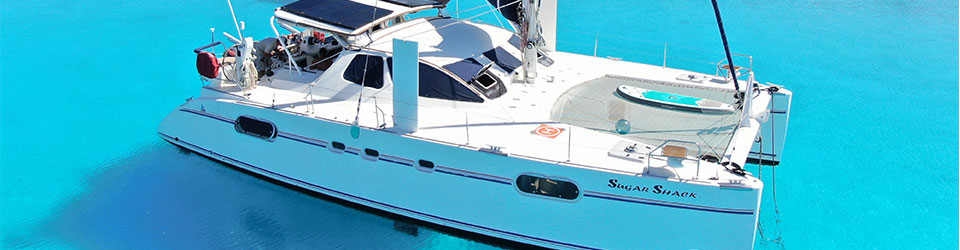
Maktea is a beautiful atoll surrounded by spectacular cliffs, rising to a plateau of 80 meters above sea level. It is a breathtaking view, once you get over close proximity of your home to the surge and shallow reef.  We spent the morning on board watching the surge and swing of the boat.  We wanted to make sure Sugar Shack was safe before leaving her alone.  Originally, we thought the surge was close in Teti’aroa, but it is much closer here.

Surge over reef at Makatea

Surge over reef at Makatea

History of Makatea

Makatea is one of four islands of the Tuamotu Archipelago (along with NukutavakeTikei, and Tepoto Nord) that do not take the form of a typical atoll.   At 113 meters above sea level it is the tallest atoll in the world.  Despite its height, it is only 4.7 miles long with a maximum width of 4.3 miles.

Forward Thinking Leadership

Julien Mai, Le Maire (mayor) is a very forward thinking, well-educated leader.  He has grand plans for the island to make it an ecotourist destination while at the same time creating a self-sustaining environment for its people.  There are about 130 people who live on the island.  14 children attend the one school all in one class.  They start school at age 2.5 years and continue until they are 11.  Then, they go to “collect” in Rangiroa for 4-5 years to continue what we call middle school in the U.S.  If they can afford it, they will then go to Tahiti to finish with high school.

Julien has installed part 1 of a two-part solar project to power the village.  Originally it took over 20 drums of expensive diesel to power the village each month.  However, Julien installed 150 solar panels and 75 batteries that now use only 2 drums per month.  Plans to complete the solar project will be complete once the population reaches 300 people.  At that time, they will expand to 300 solar panels and 150 batteries.

Solar installation at Makaea

Solar installation at Makaea

Mākatea is almost the only Paumotuan island with potable water. Its native name derived from the drinking water being brought out of its dark caves by the local people. “Mā,” pure, clear; used here to mean water, “Atea,” light of day and “K” for euphony.  The interesting thing is that the word “makatea” is actually a type of island.  The locals do not feel that this is a name reflective of the island and are hoping to change it to “Papatea” which means “white rock.”

Makatea and its soaring cliffs

Makatea and its soaring cliffs

Phosphate Mining

Makatea is one of three important Pacific raised coral islands that had large phosphate deposits (along with Nauru and Banaba).  Phosphate mining drew hundreds of people to Makatea in the years before the French Centre d’Experimentation du Pacifique (CEP) started nuclear experiments. During the large mining years from 1906 to 1966, the mining operation brought more than 3,000 workers and families.  After the end of the phosphate exploitation, Makatea was almost totally left on its own with only a few families left to guard the island.

The mining produced hundreds if not thousands of hand-dug holes across the upper plateau of Makatea. Each cylindrical hole is about 2.4 metres in diameter and 15-23 metres in depth. An unsuspecting visitor could easily fall into a hole and die while walking in the thick undergrowth that hides these holes.

Holes dug by phosphate mining

Holes dug by phosphate mining

Le Maire, Julien Mai recently brought in a specialist to evaluate the phosphate levels on Makatea.  The inspector said that good mining is considered to have 20% phosphate levels.  Makatea has phosphate levels of 48%.  The mayor is trying to get a new phosphate mining project approved.   An estimated 6 million tons of phosphate rock is available for mining.  It would take 350 people 35 years to excavate the rock.  This time, they are negotiating a repatriation of the island and a fee to the French Government.  The rock near the steps is an example of phosphate rock.

Phosphate rock near steps

Phosphate rock near steps

Please tune in to our next blog post to follow the rest of our adventures on Makatea.

Whales in Teti'aroa

A Whale of a Send Off: Passage Teti’aroa to Makatea

Teti’aroa is know for whale spotting, especially from July to November.  We had seen several spouts and watched a few charter boats do the dance around the entrance in search of a whale.  But we didn’t actually see a whale breach the water during our stay.  A little disappointed, we raised the main sail and released the mooring.  It was time to head to a new island called Makatea.  We unfurled the jib and put out our three fishing lines as soon as we left and were crossing the bay.  Then I heard Matt shout “whale.”  I ran back, grabbed the big camera and tried to capture these elusive beauties.

Under full sail with three fishing lines out we had to be careful about maneuvering the boat.  We could not just turn on a dime to go back which was frustrating, but I got a few shots of the mama whale and her baby calf.

Whales in Teti'aroa

Whales in Teti’aroa

We received a send off part just as we were passing Brando island.  A pod of dolphins came to play with Sugar Shack.  We weren’t going very fast, so I am sure it was not much of a sport to them.

Dolphins off Brando Island

Dolphins off Brando Island

Making Our Way to Makatea

We knew it would be a light wind motor sail, but we had hoped for a little more wind than what we got.  Regardless, we had full sails up, port engine running, and three lines out on our way to Makatea.

The moon rose as the sun set in perfect unison.  So gorgeous.

Moonrise and Sunset

Moonrise and Sunset

As we approached Makatea the next morning, we started preparing the boat for mooring.  I was setting the lines for the mooring while Matt brought in the fishing lines.  We caught nothing, zippo, nada during the entire trip!  As Matt brought in one of the lures, we understood why we did not hear the elusive “zing” of the line.  Someone ate our skirt as an appetizer.

Someone ate her skirt!

Someone ate her skirt!

Passage Details:

Miles Traveled:  110 nm

Duration:  20:30

Avg. Speed:  5.3 kt

Max Speed:  8.1 kt

Wind Speed:  8-10 kt

Swell:  .5

Makatea has soaring cliffs that jet into the sky from the sea’s surge.  Making a very imposing sight on entry.

Approaching Makatea

Approaching Makatea

Mooring in Makatea

There is no anchorage anywhere near the island of Makatea.  There are only three moorings that are maintained by the locals.  Lucky for us, there were no other boats when we arrived.  So we had our pick of the moorings.  A fellow cruiser told us that the mooring on the far left (red) is the best one because it is not moored in super deep water (50 meters vs 100 meters).   We circled around and found the painter sunk below the water.  We grabbed the line, threaded our two lines through loop and secured Sugar Shack.    The boat is maybe 8-10 meters away from the surge and the reef – freakishly close!

Surge over reef at Makatea

Surge over reef at Makatea

Long Lost Friends

A few hours after we arrived, we saw a boat on the horizon without AIS.  We could not determine their name so we just watched as they approached.  It did not take long for us to hear the roar of “Sugar Shack.  Hey, it’s Matt and Christine!”  Well they certainly know us….if we only knew them?  They slowly motored up next to us and it was Yves and Martha on Break Away.  We had not seen them since Las Perles, Panama (over 18 months ago).  Sweet!

We let them get settled on the furthest mooring before picking them up to go exploring in town.  We had to navigate the tricky pass that has a big surge over the reef. Lucky for us, Sweetie is equipped with a 25hp outboard.  We timed it between sets and made it in with no problem.  A quick bow anchor and stern tie to dock and we are off.  The photo below shows the surge over the reef between the two poles which is the entrance.

Entrance to Makatea Port

Entrance to Makatea Port

On Shore – Makatea

We found lots of industrial equipment, the le marie (mayor’s office) and a magasin with ice cream and wifi.  We decided to turn back before it got too dark and enjoyed sun downers on Break Away.

Old trains abandoned on the island

Old trains abandoned on the island

The map below shows the trail we will go on during our tour.  See Belvedere and Pot Hole.

Map of Makatea

Map of Makatea

The terrain was mixed between large rocks jetting from the ground to beautiful forests.  I am sure will learn more about this on our tour.

Lots of phosphate rocks on this island

Lots of phosphate rocks on this island

Returning to the port, we see our beautiful boat sitting close to the ruins.

Sugar Shack on her mooring close to the reef

Sugar Shack on her mooring close to the reef