Category Archives: Locations

Places around the world

Marlin, The Big Catch on Toau Passage

We like to fish while under passage.  On the 140nm passage from Tikehau to Toau we estimated it to take us 25-26 hours at an average speed of 5kts with 12kts of wind from the North of East.  Of course, that is if we didn’t spend a bunch of hours trying to catch a huge blue marlin

We decided to leave Tikehau between 0900-1000 so we would not arrive in the dark.  Everything started out as planned, we raised the main to full sail and had a reefed jib as we exited the pass.  Within the first hour we were hit with strong winds (20-25kt) from a squall.  Matt took a reef in the main thinking we could shake it out after the winds died down and after we made our left turn around the atoll.

Weather routing gave a direct path (as the image indicates below) but they did not take into account that we would be sailing over other islands.  So, we went around Tikehau and avoided Rangiroa and Kaukura.

Route to Toau

Route to Toau

It was a fantastic sail with 12-15kts of wind from the North, North East pushing us along at 8-9kts.  That is wicked fast for us when you consider we usually cruise at 5-6kts.  We figured it would not last and decided to enjoy it while we had it. 

The BIG catch

Matt had all three lines out and a teaser.  I did not think we could catch anything because we were going too fast.  However, around 1415 Matt noticed our teaser bungy bounce and pulled it in to find our lure missing.  Not a minute later the line next to it went “ZING!” We both looked up and saw a marlin dancing on the water.  And then off it went, unspooling thousands of feet of line and filament. And going, and going, and going. 

Since we were under sail, we had to depower the boat and bring in the other 2 lines before we could work on bringing the marlin in.  We reefed the jib and headed away from the wind slowing us down to 5/6 kts.  Matt started the slow process of reeling the beast in as I tried to slow us down even further without flogging the main or making an accidental jibe.  The pressure on the pole was constant between the power of the marlin and the forward motion of the boat making it challenging to reel the fish in.

Matt fighting with the Marlin

Matt fighting with the Marlin

He was a fighter!  Of course, I can’t blame him.  I must admit I felt horrible bringing him in and watching him suffer (what a bleeding heart).  But we will use all of his meat to feed the locals and other cruisers.  He will not go to waste and will not be a trophy hunt.

The Big Blue Marlin

The Big Blue Marlin

Once we got the fish close enough, we attempted to gaff him to help pull him onboard.  The trick is to get him close enough to use the gaff, but far enough away where his nose doesn’t put a hole in our boat.

Trying to gaf the marlin

Trying to gaf the marlin

It wasn’t pretty as the gaff kept coming out.  We had to stick him several times before we were able to finally bring him onboard.

The Big Catch

Marlin: The Big Catch

The Marlin

He is about 2.5 meters in length (7.5’) and 70-75 kilos (155-160lbs).  His nose came across our deck and his tail is off the last sugar scoop.  Who is tougher?

A picture of a full reel (top) and the unspooled reel (bottom)

We ended up filling (6) 5x large ziplock bags. I think each bag is 5gal.  Lucky for us the engle was empty so we had a place to put him.  We filled it up and still had to put two bags in the fridge!

Bagged and ready to go

Marlin bagged and ready to go

Are we sailing?

After several hours of going off course at 1.2-5kts we finally went back on track.  We headed back on course, reset the sails and we were off again at 8-9kts in 12-15kts of wind.  Sweet!  It took Matt another 1.5 hours to cut and clean the fish while I got us underway.

We finished up with the fish just as the sun was setting and as the SSB net was starting.  What great timing.  We both were too tired to make dinner, so we prepared the boat for the evening sail and set into our passage.

It was a totally smooth and fast sail.  We ended up depowering the sails again as we were scheduled to arrive at 0300-0330 in the morning (dark).  At dawn, we turned the motors on and made our way to the false pass of Toau.

Toau

Toau is known for its absolute beauty, remoteness, snorkeling, and serenity.  It is unique in that it has one pass that leads into the lagoon and one false pass.  The image below shows us (red arrow) at the false pass and it shows the regular pass on the right with the range markers and channel.

Tao

Toau

You may ask, “what is a false pass?”  A regular pass will allow yachts to enter into the atoll into the lagoon inside.  A false pass can either be from the inside of the lagoon to the outer reef or from the pacific to the inside reef.  The false pass at Toau allows yachts to enter from the Pacific to the inner reef (but does not allow us to go inside the lagoon).

Toau False Pass

Toau False Pass

We picked up a mooring ball provided by Gaston and Valentine (locals who also run a restaurant), took a quick nap and began our explorations.

Trip Details

  • Miles to Destination Total: 140nm
  • Total Miles Sailed: 142nm
  • Hours Sailed: 20:18
  • Moving Average: 7.1kt
  • Max Speed: 11.7kt

Events from this blog post occurred around the 3rd week of November, 2020.  Our blog posts run 8 weeks behind our adventures.

Tikehau Anchorage

Tikehau Tranquility

We visited Tikehau last year and frankly, it was not one of our favorite atolls in the Tuamotus.  However, we did not really give it a fair chance.  The weather was horrid and we ended up hiding inside our boat at one anchorage during most of our stay (blog post 12/2019).  So, we decided to return to Tikehau on our way through the Tuamotus.

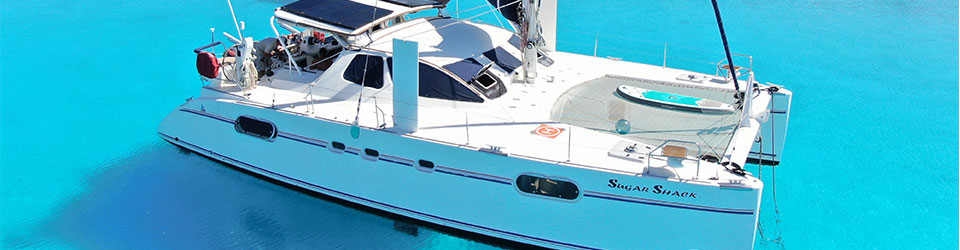
After our wonderful sail from the Society Archipelago, we had a smooth entrance through the pass and headed straight for our anchorage.  There is only one channel inside the lagoon which starts at the pass and ends at the village.  The rest of the lagoon is littered with bommies and small motus that pop up in random places.  In order to traverse the lagoon, you have to constantly monitor the charts and have a look out.  The photo below shows Sugar Shack at the pass anchorage (the red arrow), then the channel pink lines with red markers (that look like “i”) down to the village.

Tikehau Navionics Chart

Tikehau Navionics Chart

We ended up anchoring about 1 mile from the village at the first orange anchor. After the channel ended we navigated our way to an anchorage in front of the Pearl Beach Resort Tikehua.  Our friends on Jolly Dogs, Maple, and Moggy were here as well. 

Exploring the Motus

Matt and I had great fun exploring the surrounding motus in search of sea treasures.  Each motu is unique but they all share basic characteristics.  They are fairly flat, covered in coral, little bit of sand, and lots of coconuts.

The first motu we came to actually had this really pretty pinkish sand.  When the sun shone on the sand it would turn maroon, brown, and a little orange.  Really pretty.

In between the motus are little rivers or pools of water that flow from the Pacific to the lagoon.  Top photo shows us at one motu, overlooking the water between to another motu with the boats at anchor behind.

The water inside the Tikehau lagoon is really warm, like bath water.  Which is super fun, but not as refreshing as you’d like on a hot day.

Motu Tohuarei

After a few days at the Pearl Beach Resort anchorage we picked up the hook and headed to a new motu.  Only 3nm away, yet it feels like a new world.    This pretty little spit of land is literally in the middle of the lagoon surrounded by its own reef.

Matt breaks out the drone to give you a bird’s eye perspective.  Truly beautiful.

Tikehau Anchorage

Tikehau Anchorage

We explore the motu and snorkel all over the reef which are teaming with schools of fish and coral.

Blessed with a beautiful sunset each night.

Pass Anchorage

It was hard to leave considering we had this little motu all to ourselves.  However, it was time for us to head to the pass anchorage to prepare for our departure from Tikehau.  We took a new route across the lagoon instead of backtracking.  Sugar Shack have 3 sets of charts and me at the bow as a look out – so why not.

On the way, we passed by another little motu called Motu Mauu which would have been fun to anchor at if we had time.  Super pretty with lots of coral and fish around it.

Always on the look out for the bommies which can be small bits of land sticking out or coral heads just under the surface. The one in the photo was pretty easy to spot, but some are super hard to see if the sun is not just right.

Bommie hiding under the water surface

Bommie hiding under the water surface

7nm later we arrived to the pass anchorage where 9 other boats were located.  So much for the peace and quiet.   The good news is our friends on Hoodoo are here along with a lot of birds!

We enjoy snorkeling the pass and doing slow drifts with the incoming tide.  The pass is full of lots of fish including a huge school of barracudas, tons of puffers, a few eels, and flounders.

We are so glad we came back to Tikehau.  The tranquility of this little atoll (during good weather) was amazing.  The warm waters, friendly people, and pretty motus were wonderful to explore.

Events from this blog post occurred around the 3rd week of November, 2020.  Our blog posts run 8 weeks behind our adventures.

Mysteries of Mo’orea

Mo’orea is full of mysteries, legends, and culture significance. The local government throughout French Polynesia has installed markers, plaques, and signs on each of the inhabited islands to share the lore with visitors.  It is a wonderful way to learn about the island and its inhabitants if you are not fortunate enough to hear it directly from the locals.

Espace Loisirs Kultur (ELK) is a cultural center that is dedicated to educating and training the population on Tahitian culture.  They have experts come in to train people how to weave, make ukuleles, dance, cook, make costumes, build instruments (ukes, guitars, drums), agriculture, carve, and more.  They invite the young, old, local, and foreign people in to stay for up to 8 days and enjoy a true Polynesian experience.

The facility opened 3 years ago and has expanded adding a stage to showcase the student’s learnings, workshops, a garden, and living space.

ELK Education and Cultural Center

ELK Education and Cultural Center

The first teach the students to create a small uke using half a coconut shell and plywood.  As they improve the move up to the carved ukes.  They also make drums and other instruments.

In an effort to show the youth how to make money, they show them how to make the ornate costumes for the many heivas held on each island annually.  The material is bark from local trees that is worked and manipulated into fabric over the course of several weeks.  The king and queen outfits below each sold for 7000xpf ($70).

Ro’o who showed us around spoke excellent English. He introduced us to his aunt, the owner, all of the employees, and all of the animals.  I fell in love with mimi this blue/yellow eyed cat.

Snorkeling the Aquarium

We were antsy and needed to get off the boat. It had been raining here in Mo’orea for the last few days keeping us holed up inside.  So, at a sun break we decided to go for a snorkel at the aquarium.  Not the best time as there was lots of sediment in the water and it was a bit murky.  However, it we did see lots of fish.

And there were lots and lots of little Christmas trees.  I love these little guys  They zip inside when you touch the tip.

If you saw Magical Moments in Mo’orea, you already read about the sunken tikis on display underwater.  Just another wonderful bit of history or is it a mystery on how they got there?


Events from this blog post occurred during the second week of November, 2020.  Our blog posts run 8 weeks behind our adventures.