Category Archives: Locations

Places around the world

Shell Museum in Huahine

Huahine Shell Museum

Frank, the owner of Expo Coquillages (Shell Expo) or the Shell museum. He has spent 38 years collecting precious sea shells from the beach.  He has built an amazingly, organized, educational, shell museum next to his house for Huahine visitors. 

Frank has spent the last 38 years collecting and expanding on his private shell collection.  80-90% of the shells in his museum come from the beaches of Huahine and Rangiroa. He does not collect them from the sea as he does not want to kill the inhabitants for their shells.  His museum is small, but extremely well organized.  Each group of shells is in a numbered box with an index that gives their name.  In many instances. He has photos of the shell with its inhabitant.

Shell Museum Tour

Frank starts off by talking about conch shells which are both beautiful and deadly.  A “real” conch shell has an opening from the top to the bottom of the shell.  That’s how you can differentiate a conch from another similar shell.  99% of all conch shells open to the right.  Meaning if you hold a conch with the pointy part down, the opening will be to the right (top photo).  Only one type of conch shell opens to the left and they are rare (bottom photo). One in a million will open in the opposite direction for both of these types of shells.

Conch shells opening to the right

Conch shells opening to the right

Deadly Conchs

Many of these conch shells are poisonous and or deadly when they are alive.  They cause 2-3 deaths per year (similar to a shark).  But honestly who wants to admit they were killed by a small sea shell compared to a shark?  Which is why you don’t hear much about these types of deaths.

The interesting thing is that these conch shells are afraid and will retreat when threatened.  They don’t try to kill or injure humans.  It is the curiosity and greed of humans that get’s them stung.  Humans see the shells in the sea, pick them up, put them in their pocket and whamo – they get stung.  The shells cause paralysis within 2 hours and then death.  They are 32x more deadly than the cobra and there is no vaccine.

The Conch Anatomy

The conch has a snout that protrudes from the shell that does the “investigating”.  When he is in danger, he jets out his stinger under the snout.  It is so fast that you can’t see it with the naked eye.  They can sting multiple times, like a bee.  When trying to capture prey, the shell will extend its snout, then sting a fish and open its mouth to bring it to him.  Sometimes it will open its mouth so wide that it collects multiple fish.  When that happens, it stings the fish while inside his mouth (see lower right image).

Deadly Conch

Deadly Conch

These look like conch shells, but they are not.  The opening does not extend from the top to the bottom.

Shells that look like conch shells, but are not.

Shells that look like conch shells, but are not.

The conch shell grows with its inhabitant.  It is not like a hermit crab where they change shells.  These little guys are nocturnal and hide during the day.  By the time they reach the beach they are dead and can be collected and admired.

Shells, Shells, and More Shells

Frank has a gorgeous collection of over 500 different types of shells. Unfortunately, most of his presentation was in French so I had to rely on Floris to translate bits and pieces for me.  I am sure I missed a lot of the information, but I was enthralled with the beauty of the shells none the less.

And more beautiful shells

I loved seeing many of my favorite shells at this shell museum.  He had several varieties of sand dollars (I have 4 of the 5 shown in the middle picture.  I’d love to get the one in the lower left corner but have never seen one like this before!  I have several of the cone shells including one polished as pretty as the all pearl ones (top right photo).  We also have several sea urchins (lower left) and one of the super dainty shells on the lower right.

One of my favorite shells is actually part of a defense mechanism for a large shell!  I had collected many of the shells on the bottom photo with a cool swirl.  I found out from the shell museum tour that this is used to close the critter inside a large shell (see top photo).

These are all my favorite shells from the shell museum.  Check out the top left corner – isn’t it beautiful with its pearl stripes?

This display had the evolution of the queen conch shell (furthest away on right).  This shell starts small (lower left corner) and evolves over time into a queen conch with large fingers.  I am a proud owner of one of these beauties as well.

Evolution of the queen conch

Evolution of the queen conch

In another display, Frank shows long, pointy shells that he opened up so you can see the complexity of the framework of the shell.

This cool photo shows what the shell and inhabitant look like while alive (top) then you can see the dead shell left behind (red shells toward bottom).

One of his beautiful displays

Pearls

Frank also sold pearl jewelry, carved shells, and more.  He personally creates and fabricates all of the jewelry.  Some of his products are made by other locals of Huahine as well.

This was an interesting summary of the quality of pearls, their color, shape, and luster.  He also has the number of pearls exported.  Japan and Hong Kong take 87% of the pearls from French Polynesia.

What an interesting day at the shell museum.

Events from this blog occurred on 15 October 2020.  Our blog posts run 6-8 weeks behind our adventures.

Huahine Yacht Club View

Huahine Hide Out

The first weather window to Huahine opened up and we took it. Following this small window was another “blow.”  We needed to get to our Huahine Hide Out. We need to go “east” but the prevailing winds are coming from the east so it makes a sail trip difficult.  Not only do you have to tack a bunch of times, but you also head into the wind and the waves.  Well, the wind was still coming easterly but at least they had calmed down (from 25-30kts to 15-18kts).  So off we went.

We had a lovely sail with only 2 tacks which is remarkable considering we were going into the wind.  It took us a little longer and sailed a little further than planned, but we made it.  Pretty awesome day.

Passage

  • Raiatea to Huahine
  • Miles to Destination:  27nm
  • Total Miles Sailed: 40.8nm
  • Max Speed: 9.8kt
  • Avg. Speed: 5.7
  • Moving Time 7 hours 11 minutes

We took advantage of our Huahine hide out by visiting with friends, doing a few boat projects, and getting caught up on paperwork (blogs, banking, etc…)  Matt had to find and fix a few “leaks” around the hatches, we replaced a ceiling panel in the office, and we put together lists of things that need to be done when we get to Tahiti.

In between all the “chores” we had some fun too.  We hit “Izzy’s Burgers and More” several times because the food is amazing, the service is great and we love to patronize Isabel!  This is (left, back, front) Mike “Easy” Steve and Lili “Liward” Matt, Floris and Ivar “Luci Para 2” me, and Helen “Wow”

Izzys Burgers & More Huahine

Izzys Burgers & More Huahine

A few great sunsets at the Huahine Yacht Club during happy hour with 500xpf ($5) cocktails and 450xpf ($4.50) beers.

Huahine Yacht Club View

Huahine Yacht Club View

Huahine Anchorage

Matt and I usually anchor in the “flats” which is a shallow area in between the two passes.  It is less crowded and in beautiful shallow water (top photo).  Most monohulls anchor or take a mooring closer to the village of Fare (middle photo).  Our friend on Luci Para 2 (Floris and Ivar) use their kayak instead of a dinghy to protect the environment.

Not much of a Huahine Hide Out as we are out and about, but the anchorage is safe and protected.  Always a good thing.

My friends on Luci Para 2 (Floris and Ivar) take me to the shell museum.  Check out the next blog for details on our shell adventure.

We had a small weather window to get to Tahiti but we decided to wait until the next one. Why?  Because some friends of ours were playing a gig that we wanted to attend. So, stay tuned for the blog when we show you how a Polynesian concert is done!

Walk About and Small Hike

We explored with a 5-mile walk around a few bays and went half way up the mountain.  First we crossed over this lovely little bridge surrounded by gorgeous trees, plants, and flowers.

We walked along the shore and came across this sweet path with short, leaning palm trees.  I loved how uniform they looked as they reached out toward the water and sun.

Beautiful views of the Marina Apooiti Bay and hillside.

Huahine Views

Huahine Views

Back to the boat for some relaxation.

Because we are trying to fill our blog with posts through the year, some of these posts may be a bit shorter.  I am concerned we won’t have internet in the Gambiers so I am trying to populate and schedule out blogs during our stay there.  So we don’t go “dark”.

Events in this blog took place in early October.  Our blog posts run 6-8 weeks behind our adventures.

The Wait for a Weather Window

And the wait begins…We started formulating our plan after we dropped Donald off at the Raiatea airport.  The problem is that our “plan” is contingent on weather.  We need to start heading east but the problem is the prevailing winds come out of the east.  So, what does that mean?  It means we would be heading into the wind and into the seas.  Which is not conducive to sailing – which means motoring.  Motoring is no fun and uses up diesel unnecessarily…so we wait for a better weather window.

We left north Raiatea and headed to Ile Haio, south Raiatea.  Of course, the 15nm to this baie is directly into the wind.  We attempted to fly the jib a few times but it was mostly a motor.  At least now we are in a really protected, beautiful baie that positions us for our departure to Huahine.

Exploring Ile Haio

While wait, we explore.  This baie is gorgeous and super protected.  The wind could be howling outside the lagoon and we would not know it except for the white caps.  Every once in awhile we will get a rogue gust, but for the most part it is very pleasant. 

Ile Haio, Raiatea

Ile Haio, Raiatea

Matt and I explored Ile Haio.  We walked one side of the island last time.  This time we walked around the entire island.  It is not too far, 1.7 miles over sand, rocks, trees, and rivers.

We left Sweetie at the north end of the island near a copra farm.  This is actually a nice farm with a sturdy copra drying center (the lower structure) and a small shack for the workers. I think there was a bigger structure or house at one point as there are cement pillars all around it.  Behind the shack is a stone, retaining wall.  Above and behind the wall are two graves.  Most Polynesians bury their loved ones in their yards or on their property.

Copra Farm on Ile Haio

Copra Farm on Ile Haio

We found lots and lots of crab holes as we walked along the water’s edge. You have to be careful as your foot can cause a collapse of the hole dropping you into their home (top photo).  We came across another shack more inland.  This appeared to be more lived in as there was laundry on lines, chickens wondering around, and a few goats.  It was rather pretty with patches of green grass surrounding their fenced in garden with papaya and banana trees, and some other weird fruit we could not identify (lower right).

I love seeing signs of nature’s success – against all odds.  How does this tree flourish when its trunk is so badly damaged?

We finally made it back to the lagoon side and captured Sugar Shack sitting pretty.

The Plan: After “the wait”

At the first weather window, we will head to Huahine.  Hopefully only staying for a week to 10 days before being able to move on again.  At the next weather window, we will make our way to Tahiti or Mo’orea (depending on the wind direction).   If we end up in Mo’orea we will meet up with some of our friends to procure boat parts that they brought back from the states for us.  A short stay there before heading to Tahiti to provision for the season.  After that we will continue heading east to the Tuamotus then south toward Gambier for season.

Exploring By Land

Matt and I took Sweetie exploring around Nao Nao.  We wanted to go ashore, but it is a private island with signs forbidding entrance, so we stayed by the shoreline.  The west side (closest to the channel) had a little dock and small beach.  Both were adorned with beautiful, white beach furniture and umbrellas (top photo).  We approached from the channel and slowly made our way around the tip of the island.  As we came around the other side, we saw a small resort or a really nice private residence. 

Nao Nao Private Island

Nao Nao Private Island

We continued on to the east side of the island, furthest away from the residence.  There were no “prive” signs down here, so we decided a quick walk about was in order.  I know, we are now bending the law.  It was a rocky shoreline but still really pretty.

We did find this funny tree with a bunch of shells hanging from it – does that make it a shell tree?

Exploring by Sea

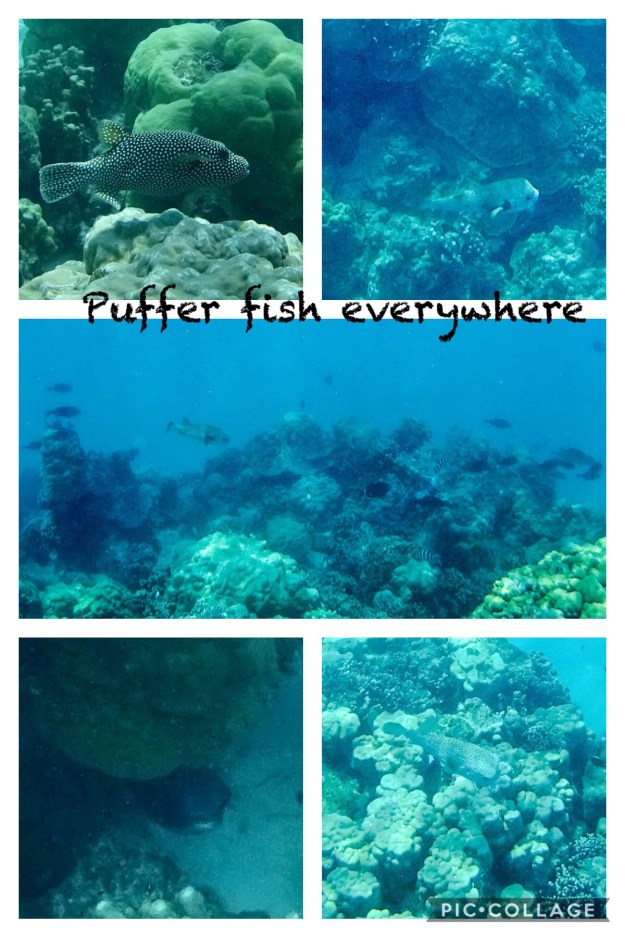
We found a wonderful snorkel spot right by the tip of Nao Nao.  We were so surprised to find so many reef fish and at least 4 or 5 different species of puffer fish.  Lots of nemos protecting their coral.

Lots of different species of puffer fish.  I just love puffer fish!

Lots of pretty fish hanging out.  Lower left corner was a group of small brilliant blue fish playing house inside a vacant clam shell.

Pretty coral heads all over

Matt then took us all the way to the reef.  He had wo bob and weave around the coral heads, but we made it.

We wait for a week before we finally get a weather window to head to Huahine – we are off tomorrow.

Events from this blog occurred between October 6-10, 2020.  Our blog posts run 6-8 weeks behind our adventures.