Category Archives: Locations

Places around the world

Dried Vanilla Bean

The Vanilla Bean Story

The best way to see all of the special places in Taha’a is by tour and the best tour guide is Noah from Vanilla Tour Taha’a.  We signed up with 4 other boats and had a total of 8 people on the 4×4 adventure.  The first stop is a vanilla bean plantation.

This post will focus on the vanilla bean and next week we will share the rest of our escapades.

VANILLA ENCOUNTER

It takes a certain artistic know how to grow this exquisite spice.  It is a skill that is acquired over time and with great experience.  Taha’a generates nearly 80% of all the vanilla in French Polynesia.  There are two philosophies to growing vanilla: (1) organically as nature would grow and (2) in a controlled environment.  When we were on Huahine we saw a small controlled grower.  (See previous blog “Safari Tour Mario from 10 September” for the controlled environment vanilla bean experience.)

Noah is a vanilla farmer and firmly believes that they best way to grow the vanilla vines is organically as naturally as possible.  But let’s back up for a moment.  Where do you think vanilla beans come from?  The primary sources of the vanilla bean are Mexico and Madagascar.  However, a few years ago Madagascar’s vanilla bean crops were destroyed so other areas, like Taha’a have flourished in production.

NATURES PROCESS

Mexico and Madagascar grow their beans outside and allow nature to take its course.  The beans are grown around a support tree.  During flowering season, a small bee will help pollinate the flower which will then grow a bean.

TAHA’As ORGANIC PROCESS

The organic or natural process in Taha is similar to that in Mexico and Madagascar.  They take a healthy vine and attach it to a support tree to climb on.  The vine will take 2-3 years to grow roots and loop around the tree before flowers start to bloom.  The photo below shows the vanilla bean wrapping around the support tree.

Vanilla Bean Attached to Support Tree

Vanilla Bean Attached to Support Tree

Once the vine is mature (2-3 years of age) it will flower.  The vines require a stressor to flower like a change in the weather.  Flowering season is typically between July and October.  Each vine will produce 10-15 flowers and each flower will produce a vanilla bean if pollinated properly.  Flowers will only bloom on the vines that are hanging down.

Vanilla Bean Flower

Vanilla Bean Flower

The Polynesians do not have the small bee to pollinate the flower so they actually do this process by hand (see above photo).  This process is called “vanilla wedding.”    They gently open the flower and remove the top of the it to access the pollen from the pistol (male).  They then open the flap of the stamean (female) to insert the pollen.

They only pollinate 8 of the 10-15 flowers to ensure the vine does not become over stressed.  Remember, each pollinated flower will provide a vanilla bean.  The stem of the flower becomes the bean which takes about 9 months to grow.

The bean will notify the grower when it is ready to be picked by turning black.  The bottom of the bean will start to turn black and within 5 days the entire bean will be black which means it is ready to be picked.  It is during this period that they are the most aromatic.

Vanilla Bean Growing

Vanilla Bean Growing

FERMENTING THE VANILLA BEAN

Once the beans are picked, they are sold to a drier.  There are over 200 vanilla bean farmers and only 4-5 driers.  Typically, it takes 4 vanilla beans to make 1 kilo of dried vanilla beans.  The farmer will get paid 20,000 xpf ($200) per kilo which does not include the drier.

The drier will take the vanilla beans, spread them out on a cotton cloth and lay them out in the sun.  They will then flip them every 30 minutes for for 3-4 hours per day.  At the end of the sunning time, they will wrap them up in the cotton cloth and store them until the next day.  The beans are massaged to help them ferment.  This process takes 3-4 months.  The beans are then ready to sell.

Dried Vanilla Bean

Dried Vanilla Bean

A dried vanilla bean will last up to 15-20 years when stored in a sealed glass jar.  That is if it was dried and fermented properly.  Once you purchase a dried bean, you can boil it to get the vanilla extract out, let it cool and store it back in its jar.  You can do this 6-8 times before you need to cut the vanilla bean to use in other ways.

As you can tell it is a very labor-intensive process that requires a great deal of skill and patience.  It takes up to 4 years to begin to see a return in your investment.  I hope you too have a new level of respect for everything vanilla.

COMING UP

Stay tuned for more adventures on Taha’a as we eat flowers, get a tatoo, visit a distillery, see part of the Heiva, and learn about health benefits of local fruits and plants.

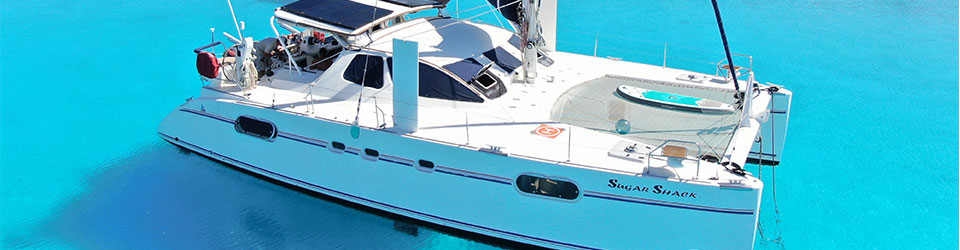
Sugar Shack is back on the water in good company with 2 other Catanas

Lightning Strike: The Highs and Lows

Originally, there were a dozen posts documenting our lightning strike catastrophe and the claims process.  But after 6+ months of living the hell, we decided not to publish any of those posts. Instead, we will publish one post and focus on the highlights and the benefits rather than all the negativity surrounding this journey.

If you are a cruiser, please contact us for your copy of “Prevention and Preparing for a Claim” which outlines key measures to take prior to claim.  We created this document with the sole purpose of helping others avoid issues and is based on our experience with our insurance carrier and being in the Pacific.

Despite all the setbacks, Sugar Shack is back on the water and we are a lot more knowledgeable of all the boat’s systems and parts.

HIGHLIGHTS:

A lighting strike can give you the blues.  However, we were elated each time new parts arrived.  It was exciting and surprising to see what arrived each time.  There was no rhyme or reason as to what arrived or when.  Some parts ordered way after others arrived first and parts ordered first arrived last.

Arrival of boat parts

Arrival of boat parts

Waiting Game

While we waited for parts to arrive, we did everything we could to prep the boat for installation.  The most time consuming project was rewiring the boat.  As you can imagine, a lightning strike can do some damage to wiring/cables.  Old cables in lower left image.

Out with the old, in with the new: Cables

Out with the old, in with the new: Cables

The Team:

We had a good team working on electronics, mechanical, and refrigeration.  Of course, Matt was extremely hands on, supervised all the work, and jumped in to ensure it all was properly executed.

AG Marine Descends on Sugar Shack

AG Marine Descends on Sugar Shack

Flaco, the tallest AG Marine worker contorted into the smallest places:

AG Marine get's into Tight Spaces

AG Marine get’s into Tight Spaces

Navigation System

All the equipment at our navigation station had to be replaced.  It was a bit of a disaster for many months as we awaited for parts to come in.  Diego had to build a new face panel to accommodate the new parts, but the end product came out really nice giving us a much cleaner, less cluttered space.

Navigation Station & Equipment Rebuilt

Navigation Station & Equipment Rebuilt

Solar Panels:

Our solar panels were fried and had to be replaced.  The new panels had different specifications, so we had to modify our existing rails to accommodate them. 

New Solar Panels Providing Energy

New Solar Panels Providing Energy

DC DIGITAL SWITCHING: POWER

The last to arrive, even though it was the first to be ordered, was our main digital switching or AC/DC control system.  Of course it had to be built, programmed, and calibrated before being sent to us.  Catana built their boats with cartes which are no longer being manufactured.  So, we replaced the system with a C-Zone system.

C-ZONE AC/DC Main Control System

C-ZONE AC/DC Main Control System

The old Digital Switching Control Panel (lower left photo) was completely destroyed by the lightning strike and is no longer available. C-Zone replaced it, which is a complicated beast, but gives us much better monitoring and access to everything remotely.  We can now control systems from this main control panel, a sub-control panel in the master suite, through B&G, and on an iPad.

DC Digital Switching Panel

DC Digital Switching Panel

BEAUTIFICATION:

We also took care of standard maintenance including wash, wax, bottom job, and prop speed.  I love the mid-way photo of the wash wax below (middle photo).

Sugar Shack get's a bath and a new wax

Sugar Shack get’s a bath and a new wax

The last color of our skirt was red and they sanded it down, painted a light blue which we didn’t like and changed it to a dark blue, which we love.

Sugar Shack get's a new skirt

Sugar Shack get’s a new skirt

Prop speed is used by a lot of fishing and speed boats.  We have never applied it to our props because it’s very expensive.  But, Bristol Marine included it for free with the cost of our bottom job.  Prop Speed prevents marine growth from bonding to metal surfaces below the waterline.

Prop Speed on our props - it's a first for us.

Prop Speed on our props – it’s a first for us.

Stepping the Mast:

Stepping the mast requires a village.  We had a rigging crew (3), yard assistants (3), AG Marine (5), painters (2), crane driver, lift drivers (3), launch slip helpers (4), a diver, and of course Matt and I.

Stepping the mast includes: carefully positioning the mast, connecting all the cables, securing the standing rigging (and tuning it), and putting the lazy jacks, sail bag, main sail, jib, and reefing lines all back on.  Then they touch up the bottom job where the blocks were located, move the crane, bring in the lift and slowly lower us into the water.

Stepping the Mast Takes a Village

Stepping the Mast Takes a Village

And she floats!  Thank God!  We had several issues once she was in the water, but we worked through them.  Both engines wouldn’t start, but after 20 minutes they were purring like kittens.

Sugar Shack is back on the water in good company with 2 other Catanas

Sugar Shack is back on the water in good company with 2 other Catanas

Outstanding Items After Splash (since repaired):

  • The radar doesn’t work (we have to exchange it for another new one),
  • Autopilot smart controller LCD screen is still funky (we are going to live with what we have)
  • The new starter battery was dead (charged her up)
  • Frigeration is on the fritz (spent 4 days working on it).

The lightning strike slowed us down and beat us up, but we are in the water and one step closer to continuing our adventures on sv Sugar Shack.

MPV Celebrating Our Departure

MPV Celebrating Our Departure

Any lightning strike is tough as you never know what it will impact. Some parts work at first, then fail, or fail, then work.  Unfortunately, there is no proven way to prevent lightning strikes.  All you can do is try your best to stay out of bad weather or zones that are prone to lightning strikes.

Vanilla Island: Tahaa l’ile vanille

How can two islands within the same lagoon be so different?  Taha’a, the vanilla island is small, serene and surrounded by motus (sand islets).  Whereas Raiatea is the second largest island in the Society Archipelago (just behind Tahiti).  Since we have yet to visit Raitea, we will focus on Tahaa as it is a gem of an island.

Life is slow on Tahaa, the vanilla island, which can sweep you away into the traditional and tranquil life of the Tahitians.  The soft mountains are surrounded by tiny motus with bright, white sandy beaches.  The island is about 33 square miles and is home to just over 5,000 inhabitants.  It is known as the vanilla island.

FAUNA OF TAHA’A

Taha’a has almost 4,000 plant species on the island.  However, only 950 are considered indigenous to the island.  Of the 950 indigenous plants, 50 came from the wind, 200 came by sea and 700 were brought by birds.  Europeans brought most of the imported flora and fauna.  Overall the island is incredibly lush and colorful with a variety of plants and flowers to admire.

Vahine Island

We went to Vahine Island after we left Taha’a.  This is a private island and did not offer much to see besides the resort.  But what it did offer was wifi out in the bay!  Yippie.

Hurepiti Bay

We left early the next morning and headed to Hurepiti Bay (pronounced “her-a-pee-tee”) where we could easily get to shore to do a tour.

This was a deep, muddy bay with lots of coral heads and reefs surrounding each edge.  We dropped our hook in 16 meters and dragged.  We picked up the hook, dropped again in 12 meters, and let out 80 meters of chain before stuck.

Sugar Shack in Huripiti Bay

Sugar Shack in Hurepiti Bay

We were invited to go on a tour with 3 other boats and this is the best place to catch the start of the tour.  We hailed the operator, Noah on the radio and he offered wifi and a brief tour of the property.

Approaching the Vanilla Tour Property from the bay:

Vanilla Tours of Taha'a in Hurepiti Bay

Vanilla Tours of Taha’a in Hurepiti Bay

Walk About to the Peninsula

We decided to take a walk around the property, up to the road, and around the bay.  The road was asphalt part of the way then turned into a dirt/grass road.  We did get some gorgeous views of the bay.

Scenic stops along the tour

Scenic stops along the tour

We also captured a few pretty sunset photos.

Breathtaking sunset photos

Breathtaking sunset photos

Back to the boat for sunset and dinner.  We are all excited about our tour tomorrow.