Tag Archives: north sails

Managing the Maintenance Part II

This is Part II of our maintenance list while on the hard at the Norsand Boatyard.  Please see “Managing the Maintenance Part I” for our work on our cross beam, sail drives, rudder arm, and props.

Here is a list of the items we worked on that are mentioned in this blog post:

  • New Scuppers
  • Paint Bow Peak Lockers (inside storage area)
  • Polishing Stainless Counter Tops (Bench)
  • Snap Shackles for Main Sheets
  • Cleaning the Interior Cushions
  • Miscellaneous Maintenance
    • Sail and Canvas Repair
    • Propspeed (Saildrives & Props)
    • Finsulate around Rudder posts
    • Window/Hatch removal of velcro
    • Teak Cleaning
    • Relabeling the clutches

Making New Scuppers

We have 17 scuppers (drains) at the bottom of the bridge deck. At some point, one of them fell off and we have not been able to find any replacements.  So, Matt decided to make his own.  

We purchased PVC white (1220mm x 300mm x3mm) plastic from Cambrian Plastics ($37USD).

Matt started by making a mold out of Plaster of Paris.  He made end plates to match the shape of the scupper and used scrap formica around the end plates.

Matt heated a cut piece of the PVC plastic in the oven at 200 degrees for 15-20 minutes.  He then took the warm piece, wrapped it around his mold, clamped it, and let it cool for 20-30 minutes.

We used a band saw or jig saw to cut out the shape, then sanded, drilled the holes, and created our new scuppers.

After we made our surplus, a friend told us about Tenob which makes smaller scuppers.

Repaint Bow Peak Lockers

The forward bow peak lockers are used for storing our spare sails, bean bags, passerelle, tons of fenders, SUP, folding chairs, and more.  

The interior paint of these two storage areas has been chipping off for years. 

It is only a cosmetic issue but it is one that has been bothering me for awhile.

The Long Process

Once the bow peak was empty, I used a metal scraper to remove all of the big flaky bits.  This process was a loud, dirty job.

I got out the power sander with attached vacuum to smooth out the walls, ceiling, floor and “V-berth.” 

It is probably 10-15 degrees hotter inside the hole.  Wearing a full suit, goggles and mask makes it seem even worse.

Next, I wiped down everything with soap and water twice. 

Then we pressure washed the entire bow peak with warm water and simple green and let it dry over night.

Matt mixed the two-part paint, Jotun Jotamasic 90 (3 parts A to 1 part B) and brought it to me.

It is specially designed for areas where optimum surface preparation is not possible or required and provides long-lasting protection in environments with high corrosivity.

The paint has a pot life of 2 hours so I had to work fast and in small increments. I started with the hardest to reach part first, the “V berth.”  It is super difficult to reach and requires full body contortion. 

But 4-hours later the entire bow locker was done.

The next day I painted a second coat and we let it out-gas for 7 days. 

Talk about a world of difference in appearance.

I also repeated the entire process on the port bow peak which was in a lot worse condition but now looks beautiful.

Stainless Countertop Polish

We love our stainless counter tops!  It does take a little more maintenance than standard counter tops but they look so beautiful!

Our countertops got marked up over the last 4 years, despite our careful management. We are not sure what caused these marks but it could be citrus, oil, salt, bleach, hard water).

We spent 4 hours masking and protecting the entire salon.  

An easy polish by Absolute Stainless and they look brand new.

We clean it twice a week with two products. 

For standard cleaning we use Weiman Stainless Steel Wipes (Amazon).  The cost ranges between $12-20 per container.

For corrosion or harder areas we use “Chemico Cleaning Paste” cleansing paste $7 (4 USD).  This paste was recommended by Absolute Stainless (the company who installed our counter tops).  

Snap Shackles

Our main sheets control our large main sail and are under a lot of pressure during a sail.  We have 16m double braid tied to a Harken Black Magic Air Becket block.  Catana custom made this block to be connected to a Wichard HR Snap Shackle (80mm) at $150USD x 2.

Our snap shackles were original to the boat and had some wear on the center clip which causes a weak point.  We had RH Precision fabricate new stainless steel pins that connected the snap shackle to the block.

More Cleaning

Cushion Cleaning: The inside of the boat got very dusty and dirty with all of the work in the yard.  So, I decided it was important to clean our interior upholstery.  We have Macrosuede fabric (color Ash) on the salon settee and the cabin benches. 

We hired JAE Cleaning Services in Whangarei to clean them for us. It was a bit of a chore getting the cushions to them, but worth it to use their “drying room.”

Of course it was raining on the day we had to transport the cushions. We wrapped each cushion in plastic to prevent it from getting soaked.

It was like playing a game of Tetris trying to fit the cushions into the car in one load.

Miscellaneous Maintenance:

Canvas:  We brought Kim (Masterpieces in Canvas) to repair and update a few pieces for us:

  • Kim made 3 new Sauleda window shades
  • Modified 2 helm back rests to accommodate the new arch
  • Made a new back rest cover for our new cockpit back rest.
  • Repaired the 2 side rain shades (put support around each snap and added velcro to hold corner when rolling up
  • Made covers for both of our bow princess seats to protect our new varnish
  • Repaired the aft shade had a small tear near the baton
  • Fixed a few small tears on the dinghy chaps
  • Replaced the top section of the starboard helm seat that got stained
  • Made 2 new helm covers to accommodate our new helm extensions and pods
  • Made a new cover for the cockpit back rest

Genoa: Roger from North Sails repaired our genoa which had a small tear near the bolt rope.  He also made a backup “Sweetie” patch for our dinghy.

Bottoms Up”

We burnished our Coppercoat which activates the copper.  We also added vinyl (from Finsulate) around our rudder posts where we once had antifoul bottom paint (which did not last).

Norsand applied Propspeed to our saildrives and props.  Matt greased the prop gears and changed all the zincs.

We added “Finsulate” a type of vinyl to the area around the rudder post.  Coppercoat can not be applied near our aluminum rudder post so added a vinyl.  

Good comparison between the vinyl around the saildrive and the rudderpost.

Each of these steps are to help prevent growth on the bottom of the boat.

Rudders

The rudders are all cleaned up and have a new bearings so it was time to install them.  The install went smoothly and took all of 10 minutes to do both rudders.

Teak Cleaning

The teak on the sugar scoops and in the cockpit were absolutely filthy.  We had dozens of workers coming and going, fluids spilled, and polish over-sprayed on them

I gave them a good scrub with teak cleaner.  I would prefer to oil or stain them but Matt likes them raw.  Perhaps next time I clean them I will out some oil on them.

Clutch Labels

We have close to 20 clutches on the boat.  Most of the clutches have labels dating back to 2001.  These labels were in both English and French and were very hard to read.

Of course, we know what the clutches do without the labels.  However, it is always a good idea to have nice, readable labels for others that might be assisting on the boat.

So, on a rainy day I took it upon myself to scrape the old labels off and put new labels on.

Lastly we washed and polished of the boat which made her all shiny and pretty.

Be sure to read about our brand new solar arch – it is super sexy!

Our blog posts run 8-10 weeks behind actual live events.

Be sure to read Managing the Maintenance Part I blog post.

We were in the Norsand boat yard working on repairs and maintenance items from November 2025 to January 2026.

Boatyard Boat Projects Before We leave

Were you wondering what Matt and I do while the Norsand boatyard crew was working hard on our repairs?  Well, you know we can’t just be idle so we finished up a few more boat projects which honestly seems like an endless list.

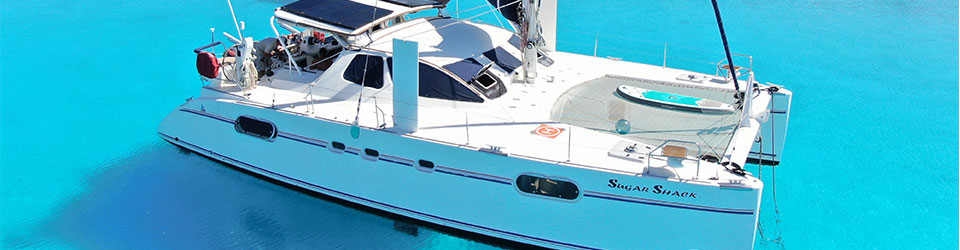
The cover photo is Sugar Shack at Norsand Boatyard.  Photo courtesy of Yum Yum who took it as they passed by heading up river.

Boatyard Boat Projects on the List

  • Replace Dinghy non-skid (under warranty, Aakron Express to repair)
  • Repair Anchor Chain Caddy
  • Replace (2) anchor chain rollers and several bolts at caddy (RH Precision)
  • Repair genoa North sail (random strings showing)
  • Re-Certify Life raft and (4) PFDs (Personal Floatation Device)
  • Clean and polish exterior stainless steel
  • Apply anti-foul to old/spare rudder and stow in forward bow
  • Get the Bauer Dive Compressor Working
  • Install bathroom accessories (see next blog post “Final Touches on Sugar Shack”
  • Installed a MeLE Mini PC
  • Service, Test, and Fill Propane Tank

Repairing the Non-Skid on Sweetie

The non-skid came off the floor, again, so we reached out to Aakron Express / Highfield to come out and fix it, again.  Luckily they were pretty responsive and willing to do the repairs.  I am glad this is not one of my boat projects (lots of glue/adhesive removal).

Last time they just pulled up the pieces that were coming lose and reglued them.  And surprise, surprise, they did not stick and came unglued again.  So, this time they completely removed all of the non-skid pieces, cleaned the bottom flooring and adhered new non-skid.  Let’s hope this sticks better.

I’m trying not to be annoyed that they did not replace the non-skid on the step.  As you can see it is still a little dirty which I can live with but it is a different color!  Ugh!

Bow Rollers for Anchor Chain

We took in two of our 5 bow rollers to RH Precision with the hopes of having new ones fabricated.  Rob, is truly the coolest dude ever!   He put in the specs into his CNC machine (bottom left) and showed us how they will look (purple lines).  As you can see, the bolts are way overdue for replacement so we replaced those as well.  The black will be our new roller (top left).

Rob surprised Matt by allowing him to come into the shop to assist in fabricating the rollers !  He showed him how to program the machine, figure out the math and then hit “go.”  Matt was thrilled which was so darn cute to see.

While the anchor chain caddy was taken apart, Matt decided to fix a few more things.  He added strong plastic to the inside panels which were indented from the chain, and he added chivs/spacers to prevent the bolts from rattling.

North Sail Genoa Repair

Our brand new North Sail Genoa had a few random strings (top right photo below) that worried us and it was not furling properly.  Roger from North Sails came by and collected it and we all took it to the large North Sail Loft in Auckland for repairs.

You can see how wrinkled the sail is when it is unfurled and it shouldn’t be that way (top left).  Guy at North Sails showed us what the 3Di fabric looks like when it comes apart (middle photo with black fabric and white strings) and that does not look like ours so they are “not concerned” with the random string we found.

The North sails engineers added more foam guides at the luff to help it roll better.  However, we discovered another potential problem with our forestay.  There were black marks on the luff of the genoa which usually indicates something is amiss with the forestay.  So, we bring in a rigger…more to come on this in an upcoming blog titled “Fine Tuning the Rig.”

Liferaft and PFDs

Our Viking Liferaft was due for service (every 3 years) so we took it to Denray Marine.  They inflated it, checked all seams and connection points, replaced the canister, and added some emergency supplies.  I know it looks like the liferaft is locked down, but it can easily be deployed with a single push of a button.

We also serviced 3 of our PFD’s and bought Matt a new one.

Cleaning up the Stainless

We have lots and lots of stainless on the boat.  It is one of my many jobs to keep it shiny and clean.  So, every 3 months I use super toxic chemicals such as Opsho, CLR, or Grunt to clean up the stainless.  However, our friends at Absolute Stainless turned me on to Chemico Paste Cleaner for our stainless counter tops. I thought I’d give it a try on our stainless exterior pieces and HOLY COW it worked amazing!  This will make this particular boat project a lot easier in the future.

We have stainless stanchions, turn buckles, line guards, pad eyes, and railings.  Each piece has to be meticulously cleaned and polished.  Most of the stainless just looks like it has a brown stain or spots which drives me crazy.  It’s hard to see in the sun, but trust me it looks bad.

The gates (upper left) get so corroded that they don’t easily open (this is after 3 months).

The pad eyes seem to get the worst corrosion, but they clean up nicely.

Spare Rudder

As you might recall, we replaced both of our rudders in November 2023 (as we lost one rudder).  We decided to keep the other “old” rudder as a spare (just in case), but it needed to be painted with anti-foul.   Matt sanded it down and I applied 4 coats of anti-foul paint so she is ready to go back into storage.

The spare rudder will be stowed in our forward port bow locked.  We stow a lot of stuff in here including: 15 fenders, 2 SUPs, passerelle, 2 folding chairs, 8 PFDs (personal flotation vests), 2 inflatable animals, SUP pump, ladder, and now a spare rudder.

Bauer Dive Compressor

Matt and I love to dive.  However, we have not had a dive compressor onboard to re-fill our dive tanks.  So, we either have had to find a local company or a friendly cruiser to fill our tanks or we just didn’t go diving (which was always a shame). 

We were able to buy a used Bauer Jr. Dive Compressor a few months ago despite the fact that we knew it would be a challenge to get it started.

The Bauer Jr. requires a lot of power to start up.  We purchased a soft start (an electrical device designed to gradually and smoothly control the starting and stopping of a compressor motor) to aid our Mastervolt inverter/charger (MASS COMBI 12/3000W-160A 220v) and our Honda EU20i portable generator.  Unfortunately, this did not start the dive compressor.  

We did verify that it started by plugging it into shore power.  So that is good news.  We talked at length to Mastervolt, the dive shop that sold us the soft start, and our electrician and they all said it should work – but it did not.

So, we purchased a new Honda EU32i portable Generator and a parallel cable.  Using the inverter/charger, the two generators, and the soft start the compressor finally started!  Yeah.  But we really did not want to have 2 Honda generators onboard – (imagine me smacking my face)!

Small Projects

As you might recall, we sort of blew up our Mastervolt inverter charger when we tried to start our “new to us” Bauer Jr. II dive compressor.  The good news, it was still under warranty as it was only a few months old!  So, Matt installed this new baby to give us 220 power!

We also finally received our brand new ITSEC 175m2 parasail.  I am so excited about this sail!  I cannot wait to fly her!  We love our new ISTEC Parasail (175m2) – she is gorgeous!

Bathroom Accessories

We also worked on our new bathroom accessory upgrades which are coming up in the next blog post titled “Final Touches on Sugar Shack.”  They are the prettiest toilets on the sea!

Programming

We use Synology Diskstation for a number of things including storage of our files, movies, books, and music.  But it is also used to monitor our electronics and run our music.  The problem is that Diskstation can be a bit of a power hog running at 3+ amps per hour.  When you are plugged into shore power or at a home it is not a big deal.  However, when you are making your own electricity and you have other power hungry sources, 3 amps can be huge.

So, Matt decided to try out a MeLE Mini-PC which is no bigger than a deck of cards.  It has no monitor and no keyboard.  But that is not a problem as we already have those.  It took Matt several days to program it, but it is working like a charm and only draws 1amp per hour!  Big Win.

The mini-PC will not be on the navigation table with all of those wires.  The photo was taken as Matt was programming it.  It will go below the nav station with diskstation.

Propane Tank

We have several propane tanks on the boat, for cooking and for the bbq. Our main propane tank is aluminum.  These tanks are supposed to be tested every 10 years but it is often difficult to find a place that will test them.  We had been filling this tank at El Gas for two seasons and they never said anything, until this time.  He refused to fill it until we got it tested at Firewatch.  it did not take long, but it did cost is $120NZ (we got a new valve as well).  The problem was she accidently stamped the tank as a 10lb instead of  20lb.  We did not realize it until we took it to El Gas and he had us take it back.  So she hammered out the incorrect info and restamped it.  Gesh what a pain.

There are two large boat projects that will get their own blog: Caulking the Sugar Scoop Teaks and Caulking the Sugar Scoop Teak.

As you can see we made the most of this haul out in the boatyard.  We completed a few more boat projects and are feeling good about our NZ departure.  We were anxious to get back in the water as we prepare to head to a new country, Vanuatu.

Best Seat in the House

We got the best spot in the yard!  We were parked right by the river on the corner which gave us great views and a beautiful breeze. The top photo is out our bedroom cabin window at dawn and the bottom is a shot from the bow.  It is not terrible to do boat projects when you have this view.

Our blog posts run several weeks behind actual live events.  This blog post on boat projects occurred April-May 2024.  In our last blog post we show you how to repair your teak deck – did you catch it?

Fancy New North Sails

Sugar Shack has been propelled by the same double layer dacron sails for the last 22 years!  Yep, you read that right, our sails are over two decades old and still propelling us forward.  Granted, the sail shape is not ideal and they look a well “used” but they still worked.  After all, they got us from Fiji to New Zealand in 6 days which is pretty darn impressive.

But it certainly was time to replace them.  We interviewed several sail lofts in New Zealand before landing on North Sails.  Roger, came prepared to talk to us about different fabrics, techniques, and sails.  He was the only one to bring us material samples and was very honest about being the most expensive sailmaker. He was right, he was the most expensive one.  

But, that is not why we selected him and North sails to make our new sails.  Roger has been manufacturing sails for 40 years.  He used to work for Doyle sails but moved to North Sails because of their 3Di technology.

The Technology of Tour Ultra X Sails

Our new custom designed main sail will be one giant sail with no seams, edges, or joints.  The corners and high pressure points will be built up to sustain heavier loads.   These sails are meant for reefing and designed to handle reefing.

The sails have a life expectancy of 8-12 years if treated well and a 5 year warranty.  We are also given a free annual check up at any North Sails location.  A repair kit is provided for us to do small minor repairs while at sea which is a simple patch and glue (no sewing).

We paid a little extra to have a mildew spray on both the main and genoa since we plan to spend a lot of time in the tropics.  The material itself has UV protection as well, but we plan to have her tucked nicely into her new sail bag when she is not in use.

Roger came by a few times to measure our sails, note the placement of reefs, attachments, battens, and mast cars.  He then heads off to place our special order.

The Sails Arrive

It took a few months to manufacture our new Tour Ultra X sails but it was worth the wait.  Roger came with our new main, battens, and genoa.

The genoa goes up first as it is the easiest.  She is a slate gray with a gray protective UV cover.  There is a small patch on the sail to protect it from our spreaders (bottom left photo).  The top right photo is our new main flaked out.

We have no problems getting the genoa on.  However, we have a few issues with the main sail.  The cars that attach the main to the mast have the wrong size screw hole.  So, Roger has to return them and get new ones.  A week later he comes back and Matt and Roger put up the new main!

Matt and Roger work diligently in the early morning to get the sail up before the wind picks up.

The full main sail up and proud – just needs some wind…

New Sail Bag

Matt had a very specific idea in mind of what he wanted in a sail bag / stack pack.  He wanted it to be low profile to keep the shadow off the solar panels.  He also wanted it to either wrap in front of or behind the mast to prevent the sail bag from billowing in high winds.  This is in addition to specifications for size, shape, style, fabric, zippers, clips, and velcro attachments.

Our old sail bag had a very high profile and a lot of extra room inside the bag (waster space).  But she was beautiful and lasted 13 years!

The new sail bag has a much lower profile, does not have a lot of extra space inside and is really kick a$$!  It took us awhile to get to where we wanted, but Roger came through in the end!  We are thrilled with the new bag.

Matt made new lazy jacks out of 4mm dynema which make it look even better.  

A few Snags

Roger from North Sails in Opua is fantastic to work with.  He is extremely professional, friendly, responsive, honest, and true to his word.  We did have a few snafus, but overall we are very pleased with our new sails.  What happened?

I mentioned above that our mast cars had to be remade because the manufacture made the screw holes a size 8 when they should have been a 10.  Also, we had two batten cars that had to be replaced because they did not fit properly.  The sail bag was supposed to be made within a week of delivering the main sail, but it did not arrive for almost 6 weeks.  Partially due to the the various holidays and bad weather, but it is what its.

However, Roger was up front with us along the way, kept us informed, and made sure we were happy in the end – and we are!

Events from this blog post occurred in early November (bidding) and in late March (initial install) thru May (sea trial).  Our blog posts run 10-12 weeks behind actual events.  Did you see our new canvas work throughout the boat in our last blog?