

Sugar Shack is its own city. We generate our own power using solar panels, engines, and/or a portable Honda Generator. We also make our own water using a Spectra watermaker that desalinates the sea. Typically, on a sunny day, we generate enough power to operate the boat. Sugar Shack has eight Solara Ultra 150-watt solar panels that can generate 1200 watts of solar.
We are considered “power hogs” compared to most of our fellow cruisers. We run 1 frigerator, 2 freezers, stereo, DiskStation, VHF, and electronics (lighting, AIS, etc…) all day. On average, we burn 12-15 amps per hour. If we are under passage, we burn a heck of a lot more while we run navigation, instruments, and auto pilot.
This is with us trying to conserve power. All the lights on the boat are LED and devices are turned off when not in use. We don’t charge devices at night because we are not making power.
On a rainy or cloudy day, we tend to use our portable Honda Generator to charge the house batteries. It is a 2000-watt, 220V generator that runs on gasoline. It’s cheaper for us to charge the batteries using the Honda Generator than it is to use the main Volvo engines. And it is way less wear and tear on the most expensive items on the boat.
Where am I going with all of this?
Our portable Honda Generator that was purchased in 2018 stopped putting out the proper number of amps and was making a horrible sound when we used it. Matt took it apart several times and discovered the stator was burnt. Crap! This must have happened when we over heated the generator while trying to weld steel for our engine’s alternator bracket (see this post) last year.

Honda Generator
We sort of forgot about the issue as we had months and months of sunny days. But as rainy season approached, we had to bring the old girl back out for service. Same problem, just different day. We decided to price out a new Honda Generator from Tahiti. If we could hire an agent to purchase the generator for us at a “decent Tahiti” price we would buy it now and ship it to Gambier. Sugar Shack will not planning on being in Tahiti for another 3 months and buying the Honda Generator now would save us from having to run the engines to charge the house batteries which saves money in the long run.
Pricing
In the U.S. you can purchase an EU20i for about $1000. In Panama, we purchased the same unit for $1800 but it included shipping from the states to Panama and the agent’s fees. Not horrible. In Tahiti, the costs are as follows:
- $2,555
- $409 (16% VAT)
- $15 – Shipping
- $437 – Agent’s fees ($50/hr x 2hrs = $100, 10% fee $296, and VAT on their services ($41)
- $3,416 total estimated cost
Our Agent told us that VAT ($409) would be waived using “Vessel in Transit” which would just about cover his fees ($437) bringing the new total to $3,007.
Most countries honor “Vessel in Transit” which allows boats to purchase items VAT/Duty free. However, French Polynesia decided to stop offering this discount because “supposedly” some cruisers were purchasing items for locals using this discount. We pitched a fit because our agent did not tell us this. Granted he said he did not know about this “new” law. We would have declined the purchase had we known the 16% VAT was being charged.
After a snit fit, we were able to get a 10% discount of $255 bringing our new total $3,161. Three times the cost of a U.S. Honda Generator. What can you do when you are in a remote third world country? Ugh.
Wrong Unit
The agent was doing us a “favor” by fronting the money and rushing the purchase of the Honda Generator. We wanted to get it on the ship which was leaving that day. The agent did work some magic and was able to get the generator on the ship that very afternoon before it left the dock. Remember, we only get the supply ship every 3 weeks so we did not want to wait 6 weeks for the next one. We emailed the agent with the specifics of the Honda Generator that we wanted. He said he purchased it, put it on the ship, and sent the invoices the following week. We did not have internet and could not download the invoices until the ship arrived.
Picking up the unit was relatively painless. We picked up our shipping invoice from the ship’s office, waited for the container to be unloaded and unlocked, grabbed our Honda Generator and went back to the boat. Immediately, realizing it is the wrong model. We had asked for the EU22i and were given an EU20i. They both will work, but the EU22i provides more power. Oh, for fuckity fuck fuck sake! Not only was it 3x as much but it is not even the correct model.
We contacted our agent who said the store did not have an EU22i in stock and if we wanted, we could send the EU20i back. We would not be able to get our shipping fees (both ways), or the agent fees refunded ($467).
Conclusion
We decided to keep the new unit because it is still better to run this EU20i than it is to run our main engines. And we expect to need extra charge over the next several months as we enter rainy season. Not an ideal transaction, but what can you do?
The good news is we have already used the new Honda Generator 3x in the first week as we had lots of rainy/cloudy days.
Events from this blog post occurred during mid to late April 2021. Our blog posts run 8-10 weeks behind our adventures.


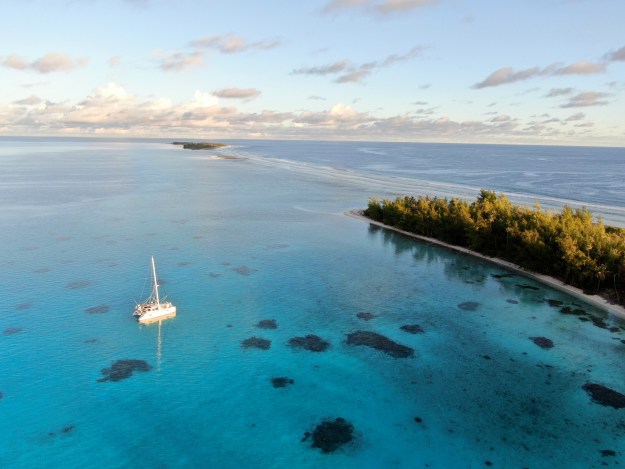
 This photo gives you an idea of how very isolated we are when we visit this small piece of paradise. This shot looks at the far left (North West) corner of Puaumu.