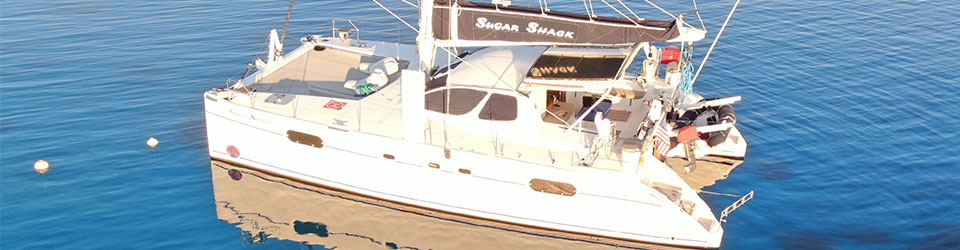


While most sailors are busy collecting sunsets, fish stories, and the occasional wayward flying fish, we’re helping collect something a little more scientific—DNA from the ocean itself! As volunteers for Citizens of the Sea we play a vital part in this scientific discovery.
Citizens of the Sea, a New Zealand-based citizen science program that equips sailors with the tools to gather valuable ocean data while cruising some of the most remote parts of the Pacific.
Their mission is simple but ambitious: use the sailing community to help scientists better understand ocean health, biodiversity, and the impacts of climate change.

Our job is to collect environmental DNA (eDNA) samples. Every creature in the ocean leaves behind tiny traces of genetic material in the water.
By towing a torpedo-shaped device called the TORPeDNA behind the boat, seawater is filtered and these microscopic clues are captured for later analysis. No marine biology degree required—just a boat, a steady hand, and a willingness to play with science equipment at sea.

eDNA Ocean Samples
The samples we collect will contribute to a growing database covering Australia, New Zealand, New Caledonia, Fiji, Tonga, and the vast stretches of the South Pacific in between. Scientists can use this information to identify thousands of species, monitor biodiversity, track ecosystem changes, and improve our understanding of ocean health across an enormous area.
Matt launches the torpedo 4 times. First to rinse it, then 3 consecutive times after that to collect samples. The torpedo drags 15 meters behind the boat for 10 minutes.
It was a bit tricky with the difficult sea conditions. We had 2-3 meter seas and 20kts of wind each time we were taking samples.
But Matt and I were clipped in and took extra precautions.

After Matt pulls the torpedo in, he drains it and hands it to me.
I remove the end cap, take it inside, and remove the gasket. Slowly and carefully, I fold the filter in three and the store it in a vile.
Next, I insert a new filter, place the gasket back on and put the end cap back on the torpedo for its next launch.

We repeat this process three times each day between 1000 and 1400 (when the sun is at its highest).
The Results
The results so far have been impressive. Participating sailors have already helped generate more than a billion DNA sequences from over 1.5 million square kilometers of ocean, all at a fraction of the cost of traditional research vessels. That’s a lot of science from a lot of salty volunteers!
We’re excited to do our small part. After all, if we’re already crossing these waters, why not help scientists learn a little more about what’s swimming beneath us? And let’s be honest—telling people we’re “collecting eDNA samples for marine biodiversity research” sounds much more impressive than saying we’re just out for a sail.
Our blog posts run 7-8 weeks behind actual live events.
We collected samples for Citizens of the Sea on our passage from New Zealand to New Caledonia. Early June 2026.
This is so cool! Thank you Christine and Matt for collecting these samples to help scientists learn more about ocean and the organisms that live in it.
I’m learning from the best! You set a wonderful example Tiffany!