Category Archives: Locations

Places around the world

Mangareva, Gambiers

The Gambier Islands are comprised of 14 islands, but only 5 of which are inhabited.  Mangareva is the largest island comprising 56% of the total land mass in the archipelago and yet it is small.  The total population is around 1,300 and the island is only 6 square miles.  Rikitea is its main town and is where the majority of the population live.  This set of islands lay well over 1,000nm southeast from Tahiti.

Polynesian mythology tells of Mangareva being lifted from the ocean floor by the demi-god Maui. The mountains of Mangareva rise over the surrounding islands and the luminous lagoon like a great cathedral. Although once the center for Catholicism in Polynesia, the people of Mangareva have returned to a more traditional Polynesian lifestyle.

Gambiers Archipelago

Gambiers Archipelago

CHURCHES AND RUINS

Many ruins can be found in the main village of Rikitea.  Among these archaeological relics are a convent, a triumphal arch, several watchtowers, a prison, and a court that have survived from the 1800’s.Most of these abandoned remains are dark and eerie feeling.

The island has become an important supply source for the Tahitian cultured pearl industry. With its cool waters and protected reefs, it supplies the majority of the pearls to Tahiti in a magnificent range of colors.

The largest and oldest monument of French Polynesia is the Cathedral Saint Michael of Rikitea.  It was originally built in 1848 and renovated in 2012.

St. Michael Church in Mangareva

This neo-gothic Catholic church was church was constructed of fired limestone and the alter is inlaid with iridescent mother-of-pearl shell.

St. Michael Church Alter

As the cradle of Catholicism in Polynesia, Gambier features hundreds of religious buildings built by missionaries and islanders alike between 1840-70. These include churches, presbyteries, convents, schools and observation towers.

St. Michael’s Church Rectory

Across the path from St. Michael of Rikitea Church is a well-maintained 140-year old rectory, occupied by the parish priest.

St. Michael’s Rectory

Relics in Rikitea

Several archaeological relics can be found by wandering around Rikitea including several watchtowers and some beautiful arches.  Most of these abandoned remains are dark and foreboding.

Rikitea Ruins

St Joseph

St. Joseph was built before 1866.  It might have been a church at one point, but now it is unfortunately rundown relic.  The columns were made of shells and the walls were made of concrete.  To the left of the church are a pair of beautifully carved statues.  Below is a photo Matt and I with a few of our friends from Agape (Josh), and Haylcon (Becca, John, Andrew).

St Joseph Monument

There is one main road around the entire island.  It is shared by pedestrians, trucks, motor bikes, dogs and hogs.

Rikitiea Main Road

Fueling in Rikitea

The island of Rikitea receives a supply ship every 2-3 weeks.  The ship brings in fresh fruits, veggies, fuel, supplies, furniture, boats, and just about anything the island needs.  It also loads up with packages and containers to take back to Tahiti.

After our 3500nm passage from Chile, we desperately needed diesel.  There are three ways you can get fuel.  You can bring your boat up next to the supply ship and a cement dock (not appealing), you can fill jerry cans (we needed 600 liters which would take us days to fill), or you can put a 200-liter barrel into your dinghy and back to your boat.  We opted for the last option.

We ended up buying fuel for 4 boats.  Sugar Shack took 600 liters and Argo, Agape and Halcyon each took 200 liters.  Argo used the jerry can method, but Agape and Halcyon followed in our footsteps by loading the barrel into their dinghies and siphoning into their tanks.  We luckily used our pump and filter, but still the process took over 6 hours (2.5 hours to order 3.5 hours to fill).

Fueling up at Mangareva

There is very little access to wifi on the island.  In fact, there is really only one place where you can find a trace of internet and that is JoJo’s.  Usually, you can sit at the restaurant side of JoJo’s when they are open, but more often than not, they are closed.  When that happens, or when cruisers just can’t afford to eat out, they congregate on the driveway in search of the wee bit of access they can find.

Cruisers internetting

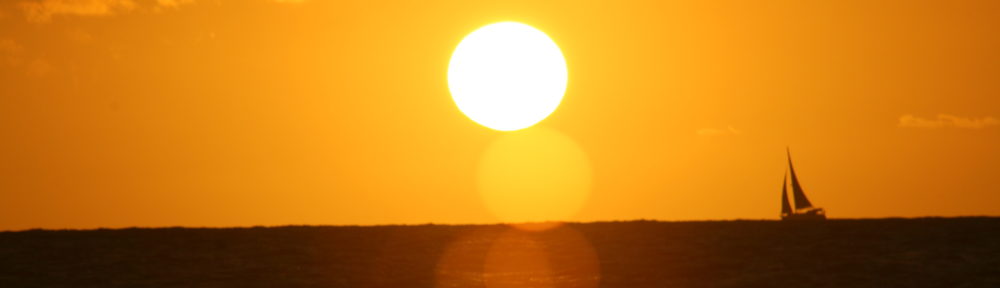
Despite the many days of howling 25kt winds, white caps in the anchorage and rain, we did have some lovely sunsets.

Mother Nature Surprises Us

When you live on a boat, you have to have a high level of respect for Mother Nature.  She can deliver some of the most breathtaking and inspiring views while at the same time sending dangerous and frightening weather.  The anchorage presented us with many gorgeous sunsets

Sunsets at Easter Island

Sunsets at Easter Island

After the 2nd night, we woke up to really rolly and uncomfortable conditions.  We were still at anchor, but it was awful.  The supply ship had already left, but the National Geographic ship was loading passengers (or at least trying).  The port captain hailed each of the 10 sailboats on the VHF.  They told us that the port would be closed for several days and that we should evacuate the anchorage.  What?  Crap!

Changing Anchorages to VinaPu

We all slowly made our way around the island to a more protected anchorage.  The only problem with the new anchorage is that there is no easy way to get to shore.  Shoot, there goes our island tour.

Not a particularly pretty anchorage either.  This is where the fuel container ship comes to provide fuel to the island.  So, we looked at huge fuel tanks on shore.  We stayed here overnight and decided we needed to go ashore the next day.  Lots to do: provision, get gasoline, and clear out of the country as our visas were expiring.  We found a semi protected area near a platform with a ladder.  We tossed out a stern anchor and crawled our way to shore.  Managing to stay mostly dry.

Luckily, we were able to get everything done that we needed.  But, because the port was closed and access to shore was challenging, we decided to leave a day early.  Much to my disappointment.  We did not get to see the largest MOAI or the largest grouping of MOAI (15).  But what we did see, we loved.  This is a spectacular island!

MOAI on Easter Island

The Moai of Easter Island

The moai are a mystery because there are so many different variations to their origins and the reasoning behind their creation, location, and destruction.  Many stories mention dissent among the people, lots of fighting and a very disruptive society.

However, based on a new study, the history has proven to be very different. This study painted a new picture of a new sophisticate and collaborative society based on excavations  four of the statues and the volcanic stone basalt tools used to carve them.  It is now believed that the full body, 13-ton monuments represent important Rapa Nui ancestors.  There are over 900 statues, many buried up to their heads due to the passage of time.  The largest statue is over 70’ tall.  Just admiring the sheer size and number is indicative of a complex, sophisticated society.

Ancient Rapa Nui had chiefs, priests, and guilds of workers who fished, farmed, and made the moai. There was a certain level of sociopolitical organization that was needed to carve almost a thousand statues.

Rapa Nui’s mysterious statues stand in silence but speak volumes about the achievements of their creators. The stone blocks carved into head-and-torso figures, average 13 feet (4 meters) tall and 14 tons. The effort to construct these monuments and move them around the island must have been considerable.  Even though, most scholars now suspect that they were created to honor important personages, it’s impossible to be certain.  Primarily because there is no written and little oral history exists on the island, so it’s impossible to be certain.

How did they build and move these giant monuments?

  1. The MOAI was outlined on the rock, a slow chiseling process.
  2. From the outline, they carved the MOAI out of the rock. The left a “heal” on its back, keeping a connection to the bed-rock.
  3. The keel is removed, and the MOAI is slid down the slope using a multitude of round trees or rocks.
  4. The MOAI is then placed in a pt so that the carving of its back can be finished.
MOAI Carving from Museum

MOAI Carving from Museum

We visited the MAPSE Museo Rapanui museum which was free and fairly easy to find.  They had pieces of MOAI along with ancient artifacts.  We discovered that of the hundreds of MOAI, less than 10 were female.  One of the female MOAI is at the museum (top right photos)

Museum Photos

Museum Photos

With so many MOAI to see it will be hard to get it all in during our short stay, but I promise you we will try!