
We are all psyched up about the arrival of our good friends, Shawn and Sharon. We anchored in Paardenbaai Key which is right by the airport. It is a fairly nice anchorage but is blowing like stink! We are seeing white caps all around us and the closest dinghy dock is the Renaissance Marina in Oranjestad Key which is a long and very wet ride. We scoped out some meeting places, found the trash, got some gasoline, and completed some last minute cleaning chores.
One of the proposed meeting spots was this cool canal that led to a tunnel into the Renaissance Mall which probably was not meant for our dinghy and 25hp (2-stroke) outboard. We were turning around when another boat came in hot and directed us out of there stat. Well, that meeting place is out, but it would have been so cool to meet them here!

Renaissance Mall Boat Canal
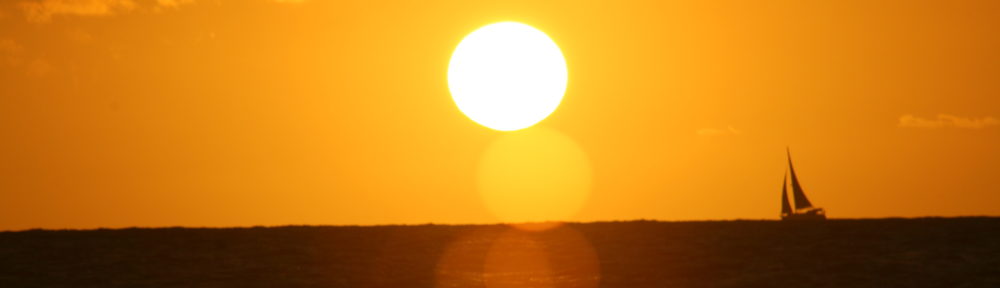
Shawn and Sharon, loaded down with bags (the biggest belonging to us containing boat parts) and brought them back to the boat to get settled. Not sure what got into us, but we decided to take a dinghy ride to explore a different anchorage. It is still blowing 30-35 kn of wind and the anchorage was on the other side of the airport by the mangroves. Unfortunately for us, it was upwind and we got drenched by the time we arrived. At this point we all wanted was a cold drink. We ended up at Amuse Sunset Restaurant which was not ready to open for dinner (at 4:30p) but they were willing to serve us drinks! We ended up staying for awhile and enjoyed a really tasty, but filling dinner as we watched the beautiful sun set on the ocean.

Sunset at Amuse Restaurant.
The wind would not let up so we could not do my noodling workout or play on the SUP. However, we were able to enjoy a nice walk each morning. On their second day, we decided to try to find a giant wholesale grocery place called Price Smart. On the way to the store, there were a dozen pieces of different work out equipment on the path – just keeping the tourists and Arubans in shape.
Price Smart is a membership box store so we joined for a year as it was a better deal than buying a one day pass (and they have locations in Columbia and Panama). They did have a lot of bulk items but were lacking in fruits, veggies, breads, and sodas which is what we were looking for on this trip. Somehow we still managed to buy enough to fill several bags so we called a taxi to take us back to the dinghy.
It was still blowing 25-35 knots so we decided to stay in for dinner. Our friend Barry on “White Shadow” (also known as “Adventures of an Old Sea Dog“ on YouTube) is on a smaller boat which was rocking and rolling, so we invited him over for pork chops on our more stable catamaran. He is a fine story teller and made a nice addition to our dinner party.

Matt, Barry, me, and Sharon
The next day we moved to Malmok Beach which is at the Northwest end of Aruba. It is in between two wreck sites and a nice stretch of beach. It is also a lot more protected than where we were by the airport. With a little less wind, 15-20 we were able try out a few water activities.
This is a very popular site for all the local charter boats, so we got up early and hit the first wreck dive called SS Antilla which is 400′ in length. Stay tuned for more on this wreck as Matt and I will dive it later. As we hopped in the water we were surprised to see the stern of the boat as it was only 7 meters away, clear as day! We barely made it to the bow of the boat when a huge “pirate ship” full of tourists descended upon us. We quickly escaped and headed back to Sugar Shack.

SS. Antilla Wreck Dive
Many a lazy days were spent at this anchorage as it was so beautiful and peaceful. Plus there was an array of entertainment watching all the charter boats, tourists, swimmers, and divers.
A look at the beach without the charter boats:

Enjoying Malmok anchorage without the charter boats.
The charter boats stop for 45 minutes at the Antilla wreck site for a snorkel first which is behind our boat…

Antilla dive site behind our anchorage.
…then make their way to the swim area which is in front of our boat.

Charter boats descend on the small swim area for 45 minutes at a time.
The SUP came out, but neither Sharon nor I were as successful as Matt. The inflatable boards are made for smaller people and they are only 8’9″ in length. The longer the board, the easier it is to balance and most people use 10’9″ boards. We did not get these particular boards because we are rock star SUPers, but rather because they were a good deal and we wanted to try them out.
Matt and I were both able to stand on the boards in Bonaire (Matt a lot easier than me), but in Aruba, with the winds and waves it was beyond ridiculous. Matt fell over twice, which he had never done before. Sharon and I fell in trying to get on and then only managed to get on our knees.
I had been “patiently” waiting for Sharon to arrive to break out a new boat toy. This sweet thang came back with me from the States in July and she has been stoically waiting to make her debut ever since. Sharon and I were enjoying the water, sitting on noodles and holding on to a line trying not to float away to Venezuela. Matt surprised us by inflating our new toy, drum roll….meet Peggy Sue.

Peggy Sue comes out of hiding.
It was a bit of a $hit $how watching us try to mount her as she was very slippery, the wind was howling, and the waves were not cooperating. Shawn and Matt had a great laugh watching us try to get on several times, but we eventually tamed the wild beast.

Peggy Sue 1, Sharon 1, Christine 0

Peggy Sue 4, Sharon 1, Christine 0,

Yeah, we win!

Yep, we are feeling pretty good about ourselves.!
We moved over to Palm Beach or hotel row for our last two nights to experience more of the island life. This anchorage is right in front of all the big Aruba hotels and has a lot of actives going on all the time.

Aruba anchorage in front of hotel row at day break
The charter boats leave and return from here, the para-sailors, kite surfers, tubers, and fishing boats are all here too – and then there is one pleasure boat – Sugar Shack. We found a good anchorage, explored a few dinghy dock options, and set out to find the best happy hour.

Parting is such sweet sorrow. It was so hard to say goodbye to our friends. They are always such a joy to have on board, so full of love, laughter, and kindness. Of course, the girl’s rule and kicked butt in dominoes the first night and then Sharon won Cards Against Humanity the next night. The boys did make a come back to tie the dominoes score but we just don’t talk about that night 🙂

Shawn, me, Sharon – ahhhh

Shawn and Sharon

Matt and I – happy day!

All sorts of trouble
Yes, Matt’s hair is that long and bleached out. He was a toe head when he was younger and those days seem to have returned.


