
New Caledonia’s tropical climate had spent millions of years weathering the island’s ultramafic rocks. Rainwater slowly leached away some minerals while concentrating others—including nickel and cobalt—into layers near the surface. In other words, Mother Nature had been quietly marinating the mountains in nickel for a very, very long time.
Nickel is one of those things you can see everywhere in New Caledonia without necessarily realizing what you’re looking at. The red-orange mountains, enormous scars in the hillsides, unusual green rocks—and even some of the economic history of Nouméa—all lead back to nickel.
The red-orange mud can be seen up close and personal at Prony Bay. This clay gets all over your shoes, clothing, feet, dinghy and boat. It is very difficult to remove.

Getty stock photos from New Caledonia
The unusual green rocks are primarily garnierite—a name used for a group/mixture of nickel-rich hydrated silicate minerals. It forms when New Caledonia’s original ultramafic rocks, particularly peridotite, are intensely weathered over millions of years.
The green color comes from nickel replacing magnesium within these minerals. The more nickel-rich varieties can be an almost startling bright green

This photo came from Ilo Casy. You can see the green pockets sprinkled on the hillside.

Mining Started
Early miners literally dug the ore out by hand. By the late 19th century, the nickel rush was in full swing, attracting companies and workers from around the world. Thio became an important mining center, and the Société Le Nickel (SLN) was established in 1880.
The industry grew from pickaxes and wheelbarrows into enormous open-pit operations.

By the 20th century, the landscape around some mining areas looked less like a tropical paradise and more like someone had taken a giant bite out of the mountain.
New Caledonia’s Nickel Today
And here’s the fascinating part: New Caledonia is still one of the world’s significant nickel producers. In 2024 it ranked fifth globally, producing about 10% of the world’s nickel. This metal remains a major part of the territory’s economy and exports.
But nickel has become a complicated relationship.
The metal is valuable because it’s used in stainless steel, alloys and increasingly in technologies associated with the energy transition.
Yet mining comes with environmental costs, particularly on an island famous for its extraordinary biodiversity. Mining can remove vegetation and topsoil and send sediment into waterways and coastal ecosystems. Recent research has documented the long-term effects of terrestrial mining on New Caledonia’s coastal environment.

And economically, the nickel industry has had some seriously rough seas lately. New Caledonia has faced falling prices, intense competition from Indonesia, energy costs, mine closures and the broader economic and political turmoil of recent years. In 2024, nickel production and the wider economy were hit particularly hard.
In 2025, New Caledonia’s metallurgical operations produced more than 72,000 tons of nickel, a substantial rebound from the previous year.
We did not visit any of the nickel mines but we did get the “pleasure” of seeing them hard at work. In Prony Bay you get the mud color all over your feet, shoes, clothing, dinghy, and boat. In addition, the rising smoke leaves all sorts of yuckiness on your boat.

So next time you’re sailing past one of those strangely red mountains, take a closer look.
You’re not just looking at dirt.
You’re looking at a geological jackpot that helped build modern New Caledonia—and a resource that has been both blessing and burden for more than a century.
Not bad for a bunch of rocks.
Our blog posts run 4-6 weeks behind actual live events.
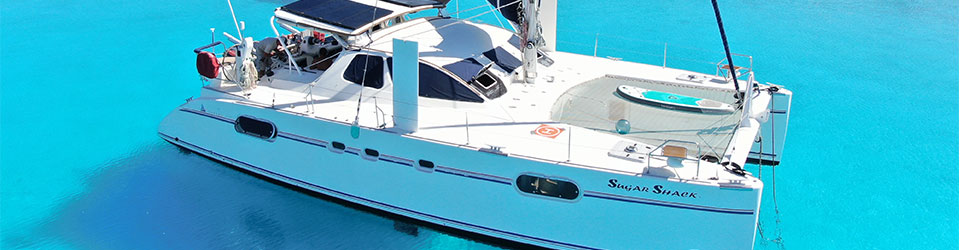
Follow Sugar Shack on No Foreign Land.