Tag Archives: new cal

Îlot Goéland: The Tiny Island With a Big Secret

Just offshore from Nouméa sits a little sliver of paradise with a rather unassuming name: Îlot Goéland. Translated from French, goéland means “seagull,” which seems perfectly appropriate for an island surrounded by turquoise water, coral reefs, and enough seabirds to make you feel like you’ve wandered into their private beach club.

Of course, the minute we land on shore all of the birds fly away….but I captured a few.

In the center of the island is vegetation that make perfect nesting grounds for these birds.

And even thought we did not see flocks of birds, we did see their amazing tracks all over the island.

Goéland is a small coral islet in the New Caledonian lagoon. It is uninhabited, beautifully wild, and protected as a nature reserve.

Beneath the surface, however, things get considerably busier.

The waters surrounding Goéland are home to colorful coral gardens and an impressive assortment of tropical fish.

Ilot Goeland’s Important Role

But Goéland isn’t just pretty. It is also an important little piece of the lagoon ecosystem.

New Caledonia’s lagoon is one of the world’s great marine environments, stretching around Grande Terre and containing more than 20,000 marine species. Its reefs, seagrass beds and tiny islands provide food, shelter and breeding grounds for an extraordinary variety of marine life.

And here’s where Goéland gets serious about its beauty.

Every year, from October 1 through March 31, access to the island and the surrounding 200-meter reef zone is prohibited. Why? The island becomes prime real estate for roseate terns, delicate seabirds that come here to nest.

It’s a pretty good reminder that paradise isn’t always about what we want to do there.

The Island

The island itself is typical of many of New Caledonia’s tiny coral islets. Some of these islands are literally built from broken coral fragments carried and deposited by currents over time. Eventually vegetation takes hold, roots help stabilize the island, and voilà—nature has constructed another postcard.

Goéland is hard to resist: clear water, coral, wildlife and that unmistakable feeling of being somewhere wonderfully remote—even though Nouméa is just a short boat ride away.

Find Ilot Goeland on No Foreign Land.

Our blog posts run 6-8 weeks behind actual live events.

We visited this small island in early September 2026.

New Caledonia Nickel: The Green Gold Beneath Our Feet

New Caledonia’s tropical climate had spent millions of years weathering the island’s ultramafic rocks. Rainwater slowly leached away some minerals while concentrating others—including nickel and cobalt—into layers near the surface. In other words, Mother Nature had been quietly marinating the mountains in nickel for a very, very long time.

Nickel is one of those things you can see everywhere in New Caledonia without necessarily realizing what you’re looking at. The red-orange mountains, enormous scars in the hillsides, unusual green rocks—and even some of the economic history of Nouméa—all lead back to nickel.

The red-orange mud can be seen up close and personal at Prony Bay.  This clay gets all over your shoes, clothing, feet, dinghy and boat.  It is very difficult to remove.

Getty stock photos from New Caledonia

Getty stock photos from New Caledonia

The unusual green rocks are primarily garnierite—a name used for a group/mixture of nickel-rich hydrated silicate minerals. It forms when New Caledonia’s original ultramafic rocks, particularly peridotite, are intensely weathered over millions of years.

The green color comes from nickel replacing magnesium within these minerals. The more nickel-rich varieties can be an almost startling bright green

This photo came from Ilo Casy.  You can see the green pockets sprinkled on the hillside.

Mining Started

Early miners literally dug the ore out by hand. By the late 19th century, the nickel rush was in full swing, attracting companies and workers from around the world. Thio became an important mining center, and the Société Le Nickel (SLN) was established in 1880.

The industry grew from pickaxes and wheelbarrows into enormous open-pit operations. 

By the 20th century, the landscape around some mining areas looked less like a tropical paradise and more like someone had taken a giant bite out of the mountain.

New Caledonia’s Nickel Today

And here’s the fascinating part: New Caledonia is still one of the world’s significant nickel producers. In 2024 it ranked fifth globally, producing about 10% of the world’s nickel. This metal remains a major part of the territory’s economy and exports.

But nickel has become a complicated relationship.

The metal is valuable because it’s used in stainless steel, alloys and increasingly in technologies associated with the energy transition.

Yet mining comes with environmental costs, particularly on an island famous for its extraordinary biodiversity. Mining can remove vegetation and topsoil and send sediment into waterways and coastal ecosystems. Recent research has documented the long-term effects of terrestrial mining on New Caledonia’s coastal environment.

And economically, the nickel industry has had some seriously rough seas lately. New Caledonia has faced falling prices, intense competition from Indonesia, energy costs, mine closures and the broader economic and political turmoil of recent years. In 2024, nickel production and the wider economy were hit particularly hard.

In 2025, New Caledonia’s metallurgical operations produced more than 72,000 tons of nickel, a substantial rebound from the previous year.

We did not visit any of the nickel mines but we did get the “pleasure” of seeing them hard at work.  In Prony Bay you get the mud color all over your feet, shoes, clothing, dinghy, and boat.  In addition, the rising smoke leaves all sorts of yuckiness on your boat.

So next time you’re sailing past one of those strangely red mountains, take a closer look.

You’re not just looking at dirt.

You’re looking at a geological jackpot that helped build modern New Caledonia—and a resource that has been both blessing and burden for more than a century.

Not bad for a bunch of rocks.

Our blog posts run 4-6 weeks behind actual live events.

Follow Sugar Shack on No Foreign Land.  

Reef Days and Island Ways

What do you do when you need a little solitude?  You head to the reef.  

The forecast had a week of very light winds and we had some underwater projects to tackle.  

Just 11nm from Noumea (the capital of New Caledonia) is the beautiful, secluded Grand Recif Abore (Grand Abore Reef).

There is not much protection here so you really need to come when the weather is just right.

We had absolutely glorious weather with light winds and very little swell (even during high tide). 

Just look at these colors!

It felt like our own piece of paradise.

One shot is looking north and the other is looking south.

Just, Matt, myself, and the beautiful blue ocean.

Please Tell Me that Isn’t So?

Believe it or not, I have not been in the water for over a year.  Yes, I know, I live on a boat.  But the water has been very, very cold (60’sF or colder)!  We did not get in the water at all in New Zealand and only a handful of times in Fiji.  (This is me smacking my forehead).

It was time to suit up and jump in the water. 

We had two big projects to tackle. 

First, we had to clean the bottom of the boat including the waterline, both hulls. and all of the niche places (thru holes, behind the dagger boards, refrigeration and SSB plates, rudder, props, saildrives, etc.).

We also had to change the zincs on the props and fix a little “wiggle” that we noticed the last time we motored.

Even though the water temp was about 74F – I was freezing!  Normally I could finish the entire boat in about 4-5 hours.  However, I could only do one side before I was breathing funny and called it a day.

I jumped in the next day to finish the other hull while Matt worked on the props.

Bonus

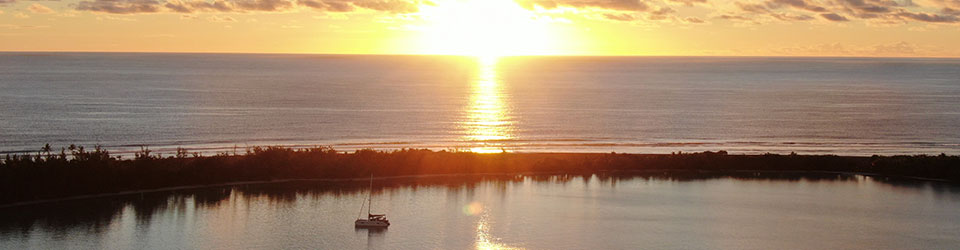
We had some spectacular sunsets and sunrises.  With unobstructed views of both.

Another spectacular bonus was that there are thousands of sand dollars under the boat!

We were anchored in about 4-5 meters of water which is just at my limit for free diving.  

But, I was very tempted to get the dive gear out to pick up some new collectables!

All of the black spots under water are sand dollars (they are actually white but the camera picks them up as black).  

Our blog post runs 4-6 weeks behind schedule. 

Find Grand Recif Abore on No Foreign Land.

We hung out at the reef for a week (Aug.2026) and enjoyed the solitude and beauty.