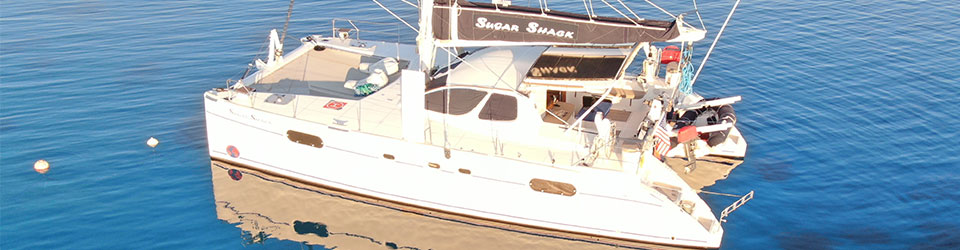

Ile Nge is a perfect, little tropical paradise —also known as Îlot Larégnère. This little ilot is only about 1.5 hours away from Noumea!
- Soft, white sand? Check.
- Turquoise water? Absolutely.
- Coral reef? Everywhere.
- Seabirds? Yep.
- Turtles? Living in the anchorage.
- Dugongs: They’ve been known to drop by.

But Larégnère is more than just another pretty patch of sand in New Caledonia’s spectacular lagoon.
So… what’s in a name?
You’ll see the island called Île Ngé, Îlot Ngé, Île Larégnère or Îlot Larégnère, depending on the chart, map or website you happen to be reading. Confusing? A little.
And tiny is definitely the operative word. The island itself covers less than a quarter of a square kilometer, while the surrounding protected marine area is vastly larger.

The real star is underneath
Larégnère is a protected natural reserve and a bird sanctuary. Southern Provence established the reserve to protect its coral formations and the marine and bird life that depend on them.
And what lies beneath that impossibly blue water is pretty impressive.
Studies and local tourism information have recorded well over 145 species of fish around the island and reef. Parrotfish and damselfish are particularly common, turning a simple snorkel into something resembling an underwater bustling neighborhood.

We had a pod of dolphins including a baby and its mother, hanging out with us for about 20 minutes as we entered the lagoon.

Several turtles lived under the boat. Ashore we found lots of sea snakes and a Portuguese Man-O-War (eek).

The Breeding Birds on Ile Nge
The surrounding reef also provides habitat for an impressive variety of marine life, while the island itself serves as a nesting site for seabirds.
There are six species of nesting birds (Australian gull, osprey, black noddy, fairy tern, diamond tern, and Pacific Shearwater) that breed on this island.
In the center of the island is a blocked off area where one of the birds nests underground. They build 1 meter long tunnels beneath the sand. The baby chicks would be crushed if humans stepped on the sand above the tunnel.

The osprey were out of their nests, feeding, and watching. We caught one during lunch (top left), a large nest, and two other beauties.

And then there are the turtles and dugongs that feed on the plentiful sea grass below the mooring field.
Larégnère has been identified as a nesting site for loggerhead turtles, adding another layer of importance to this otherwise tiny tropical island.
A sailor’s kind of island
For cruisers, Larégnère has another attraction: it feels wonderfully removed from Nouméa without actually being very far away.
Several covered picnic areas have been established as well as two toilets and a BBQ area. Making this the perfect place to spend a lazy afternoon.

Small island, big personality
Île Ngé/Larégnère may be tiny, but it packs an impressive amount into its little footprint—beautiful beaches, thriving reef habitat, nesting seabirds, turtles, dugongs, dolphins and some seriously spectacular sailing scenery.

Test your Tracking Skills
Amazing trails of a variety of footprints could be found all over the island.
We had tons of different bird tracks.

A variety of snake tracks. Super interesting to see the different wavy tracks based on the snake’s trajectory.
And we found two little crab type tracks. The top left photo shows a long track connecting to a heart shape. This track was created by the little fellow in the top right corner.
Then there was another little guy who had a super long trail coming toward us.
And of course, the only thing we left behind were our footprints (bottom right).

It’s the sort of place that makes you understand why New Caledonia’s lagoon isn’t merely something you sail through.
Sometimes, it’s the destination.
Find Ile Nge (Laregnere) on No Foreign Land.
Our blog posts run 6-8 weeks behind actual live events.
We spent 2 days at Ile Nge (Laregnere) in the beginning of September.


